




Robin E. Williams homeschooled her five children (four with dyslexia). She has counseled others on homeschooling for over 15 years and has worked in customer service for All About Learning Press for a decade.
So you have discovered that your child has dyslexia. You may be concerned and anxious over what this means for your child, or you may be relieved to now have a cause for all the difficulties he has been experiencing. Regardless of how you are feeling, however, you need to let your child know.
I’ve been there, and I can tell you it’s not that bad. By the time you have noticed enough issues with your child to start looking into dyslexia, your child is probably already aware something is different with himself. Knowing that there is a reason for this learning difference was a relief to my children.
Speaking about dyslexia openly with your child as often as he desires shows him it is not a shameful thing to be hidden away. It is a part of what makes him the wonderfully unique person he is!
Prepare yourself.
Before you talk with your child about dyslexia, you need to understand it well enough to be able to explain it on your child’s level. Take a bit of time and read up on it. Start with a Definition of Dyslexia and then read through the many articles on our Dyslexia Resources page.
But don’t take too long. When a child is given no explanation of his learning differences, he can only assume it’s his fault and he must be stupid. It’s best to help your child understand what’s going on as soon as possible.
Plan your talk.
Plan to speak to your child about dyslexia in a peaceful moment, taking care to reduce anxiety about this conversation. Be willing to put it off for tomorrow if you or your child has had a bad day. You want everyone to be calm and ready to listen.
For this first introduction to dyslexia, speak to your child alone without siblings or extended family. Everyone will naturally have questions, and this will give your child the unrushed space to ask his questions first.

Know that this will not be a one-time conversation; the topic will come up again and again throughout your child’s life. My children are adults now, and dyslexia still comes up from time to time. Stay ready and open to discussing it whenever your child feels the need.
What to say.
Tell your child that his struggles in reading and spelling are caused by something called “dyslexia.” People with dyslexia learn differently than others because their brains are different. Brains send information along pathways called “neuropathways,” and in a dyslexic brain, the pathways for words and language aren’t as clear or easy to follow. So, the brain has to work harder to use the information.
Be sure to explain that your child is not alone in this! Many other people have dyslexia too; that’s how scientists and other people know so much about it. Since dyslexia very often runs in families, you may be able to mention family members who also have it. If you know of others with dyslexia, mention them too. It’s very reassuring to children to know that it’s not only them. And it’s extremely encouraging to hear of others with dyslexia who also struggled to learn to read and spell but were ultimately successful.
If you don’t know anyone with dyslexia, mention my son Jude. He had so much trouble learning to read, spell, and write. It took many years, but he now reads, spells, and writes as well as all of his friends and most other people. He’s 21 years old now, a certified welder, and is working toward establishing his own business. Here is a photo of him when he was struggling with spelling and a photo of him now with his truck.

There are other stories of dyslexic students having success on our blog. One of my favorites is Dyslexia and Hope.
This may be all your child can handle in the first conversation. However, if he is ready for more, you can continue. Otherwise, there are topics to bring up in later, less-planned talks.
What to say next.
Reassure your child as often as he needs to hear it that he will learn to read and spell, and there will be a time when reading and writing are not hard for him. You will be helping him to learn, a team working together, teaching him in the way that he needs to learn. It may take a long time, but he will be successful!
It’s important that your child knows that having dyslexia does not mean that he is not smart. Intelligence and dyslexia are not connected at all. It just means he learns differently. If you think he may understand, go over the A Parent’s Guide to the Neuroscience of Dyslexia with him.
Make it clear that it is no one’s fault that your child has dyslexia. It is simply a part of who he is.
Talk with family too.
It’s also important to discuss your child’s dyslexia with siblings and extended family. Grandparents may be concerned about your child’s reading struggles, and they need to know that there is an underlying cause and you are addressing it. Your other children will notice that their dyslexic sibling needs more help and one-on-one teaching, and they need to know why.
Openly discuss with your child and his siblings how everyone has strengths and weaknesses. We tend to want to avoid discussing weaknesses, but since a dyslexic child’s weaknesses are so apparent, it’s essential for him to hear that others struggle with things he finds easy.
Talk about your weaknesses too. I know it can be hard to be that transparent with your children, but they’ve probably already seen some of your weaknesses anyway. My children were well aware of my poor navigational skills because of how many times they were with me when I got lost, but I also candidly spoke of my difficulties with being sympathetic to others. It is something I still work at.
When you discuss your child’s strengths, don’t overlook less tangible things. My son Jude is so good with people and always has been. He puts them at ease, and people he has never met before genuinely enjoy spending time with him. His strengths in interpersonal skills are extraordinary and as worthy of admiration as a gifted student who is years above grade level.
Give ongoing support.
When you work with your dyslexic child, it is important to praise effort as much as results. “I noticed how hard you thought about that word before you spelled it. Great work!” This goes a long way toward acknowledging the effort your child is giving. The hard work that goes into even small amounts of progress is all too easy to ignore because it’s all internal. So it’s important that your child knows you notice his hard work. Here are even more ways to be encouraging.
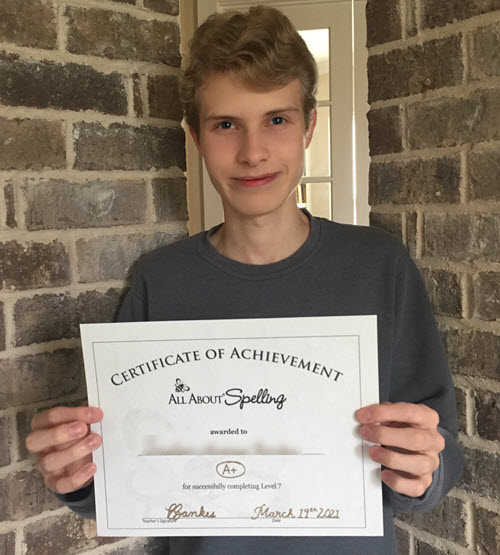
But also celebrate success! When he reads a story with fluency, tell him so with a high five. When he finishes a level, do something extra special! Take a photo. We love seeing smiling students holding their Certificates of Completion! Go out for dinner, or shop at a bookstore. With my kids, I also gave them a full week off of a subject when they finished a level. No spelling for a week was refreshing after all the hard work!
Encourage and support your child in pursuing activities that he is good at and enjoys. If he doesn’t have something he is good at, then make a plan to try lots of new things until he finds it. A struggling learner needs to have something that he can shine in!
Talking with others.

You need to be prepared to advocate for your child with other adults that he interacts with. Co-op teachers, club organizers, and maybe even sports coaches need to be aware that your child may need more help than his peers in reading and writing. Discuss specific kinds of help your child may need, and offer suggestions for how this can be done in ways that won’t overload the other adult.
If at all possible, have your child be present for these discussions. In time, he will need to learn to advocate for his own needs, and seeing how you approach it will help him when the time comes.
Help prepare your child for what to say to friends and peers. Even after he learns to read and spell well, he will make mistakes that others will notice. All of my children have experienced this more than once. When they are older, a simple “I’m dyslexic” is all that is needed because teens and adults know enough about it to understand. But when your child is younger, teach him to say, “I’m dyslexic. That means my brain works differently, and sometimes I make mistakes or need help.”
What to do when a younger sibling overtakes your child with dyslexia.
Occasionally, a younger sibling will learn much more easily than your dyslexic child and will move ahead of him in a subject. This can cause hard feelings. Your dyslexic child may feel very bad that his little sister is doing better than him, and the younger sibling may become competitive and boastful.
The best thing you can do is approach it head-on. My son Jude was surpassed in math by his younger brother, who is two years his junior when they were in 4th and 2nd grades. The disparity was clear; even with different math curricula, it couldn’t mask the fact that his younger brother had already mastered concepts that he was still struggling with.
So, we had lots of discussions about strengths and weaknesses. Jude’s weakness in math was on display, so, with gentleness, I pointed out some of my younger son’s weaknesses. And it just so happened that one of them matched up with one of Jude’s strengths. They knew that Jude was good with his hands, always fixing things and making things, but he found math hard. His younger brother excelled in math but found using his hands for things difficult and struggled with even simple tool work. Both had to work harder at their weakness and did so for years. Jude did finally master algebra, and his younger brother went on to rebuild a truck engine.
In conclusion…
Discussing dyslexia with your child is an ongoing conversation rooted in support and understanding and is a part of our overall commitment as parents. After all, isn’t the essence of our role as parents to provide unconditional support and understanding to our children, regardless of their challenges? This caring and open approach goes beyond dyslexia and encompasses all aspects of our children’s growth and development. We are creating an environment where our children feel valued, understood, and empowered to overcome difficulties and face all of life’s challenges!
All About Reading and All About Spelling proved to be the perfect tools for helping my dyslexic children become so good at reading and spelling that people are surprised to hear they are dyslexic. I’m always happy to help you with any questions you may have!


Comments
No comments yet. Our team reads and replies to every one.