


Some kids are just naturally “good spellers.” And then there are those who need all the help they can get.
If spelling doesn’t come easily to your child—or if you want to get your child started on the right foot—this post is for you! Read along to learn about four powerful spelling strategies to help your student, including free resources to get you started.

-
Phonetic Spelling Strategies
Phonics is the perfect place to start. When done correctly, phonics teaches a child how to listen for each sound in a word and then how to represent each sound with a letter or combination of letters.
The ability to hear the individual sounds in words is called segmenting. You can see how we teach segmenting in the video below, or find out more in our Segmenting blog post.
Would you like to give it a try with your student? Download this free segmenting activity.
After learning how to segment, your student will represent each sound in a word with a letter or letter combination, also known as phonograms. Phonograms include the letters of the alphabet A to Z, as well as combinations such as CK (for the sound of /k/), SH (for the sound of /sh/), and OW (for the sound of /ow/).

If you are new to phonograms, be sure to check out our comprehensive article on How to Teach the Phonograms, including free printable activities and a free app.
-
Rule-Based Spelling Strategies
Though hundreds of words can be spelled phonetically, there are often several possible spellings for the same sound—the sound of /j/ can be spelled J, G, or DGE, for example—and that’s when knowing some rules comes in handy.
The Kids’ Club Rule™ is a great example of a reliable spelling rule.
This rule helps you determine whether to use C or K for the sound of /k/ at the beginning of words such as kitchen and camp. You can download the rule poster here.
Spelling rules are easy to demonstrate with the Letter Tiles app or the physical tiles. Here are some more ideas for incorporating spelling rules into your teaching:
- Silent E: When your student knows all the jobs of silent E, spelling is much easier.
- Open and Closed Syllables: Knowing these two syllable types will enable your student to accurately spell hundreds of words.
- Making Words Plural: Unravel the mysteries of making words plural with six scoops of ice cream.
- Floss Rule: This simple spelling rule helps kids remember when to use a double consonant at the end of a word.
- Avoid false spelling “rules”: “False rules” can lead to spelling confusion! This well-known spelling rule is actually false 60% of the time.
-
Visual Spelling Strategies
Sometimes phonics and spelling rules aren’t enough. This is where visual spelling strategies come in. Does the word look right? Good spellers often try spelling a word several ways to see which way looks correct.
This is why we use word banks in the All About Spelling program. Each word bank focuses on one concept, such as the sound of /er/ spelled UR, and helps build the student’s visual memory of words related to that particular concept.

After becoming familiar with UR words, the word nurse spelled nerse will look wrong, prompting your child to correct her own work. Visual memory is important when it comes to correctly using homophones, too, like pray and prey or tale and tail.
Extensive reading and word games are a huge help in building visual memory. Be sure to check out some of these resources:

Rev up your review with Drag Race, a fun reading and spelling review activity. Ladies and gentlemen, start your engines!

Your young swashbucklers can turn up the fun on spelling review with our Pirate Ship file folder game. Ahoy there, matey!

Reviewing spelling words can be easy and delicious when you have a Popcorn Party! Don’t forget the butter and salt!

When two words get “smashed up” to form a new one, you get a portmanteau! Make a few of your own with Bingo Smash-Up!
Find even more fun with words here!
-
Morphemic Spelling Strategies
Morphemes are the smallest units of meaning. Morphemes include roots and base words, prefixes, and suffixes, as in the word invisible.

An understanding of morphology helps kids spell words like knowledge and action even though the base words know and act change pronunciation. That’s why All About Spelling teaches words with Greek and Latin roots, how to add prefixes and suffixes to base words, and how to form compound words and abbreviations.
For a taste of how understanding morphemes can help your student, check out this 30-second Word Tree demo and download your free Word Tree printables.
So there you have it: the top spelling strategies that good spellers use. If your child is a struggling speller—or if you want to help your child reach the next level—be sure to incorporate these strategies in your lessons. That’s exactly what we’ve done in the All About Spelling program!
Where does your child fall in the continuum from natural speller to struggling speller?
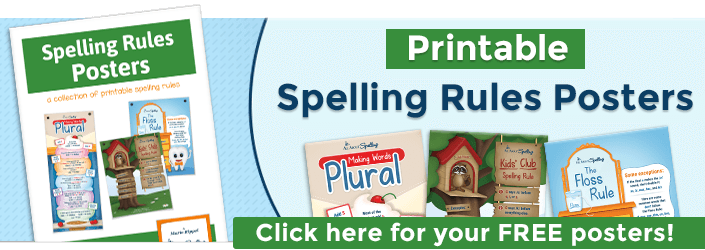
Be sure to download our free spelling rules posters for extra reinforcement!


Comments
No comments yet. Our team reads and replies to every one.