


The English language is full of unique colloquial sayings and expressions known as idioms. Exploring their definition and characteristics is essential to teach idioms. To effectively teach idioms, let’s first explore their definition and characteristics.
Idioms, which are fun and colorful expressions, have meanings that differ from their literal interpretations. Helping children understand and learn idioms improves reading comprehension and vocabulary.
If someone tells you not to bite off more than you can chew, they are not cautioning you about the size of the morsel of food on your fork. And if something costs you an arm and a leg, it doesn’t mean you have to pay with an actual arm and a leg … thank goodness!
These sayings are called idioms and teaching idioms is a piece of cake! (See what I did there? ?)
What Is an Idiom?
An idiom is a saying that has a meaning that is different from its literal meaning. Idioms are fun expressions that are commonly used to describe things in a colorful way.
Here are a few more common idioms. Do your kids know what they mean?
- a penny for your thoughts
- you’re driving me up the wall
- go back to the drawing board
- the best thing since sliced bread
- a dime a dozen
- barking up the wrong tree
- when pigs fly
How Do We Teach Idioms?
Because idioms are common in English speech and literature, it’s important for children to become accustomed to hearing them. Learning and understanding idioms will help develop your child’s reading comprehension and build his vocabulary.
Now, let’s take a look at how we teach idioms in the All About Reading program.
See pigs fly with this idiom activity and story from All About Reading Level 3.
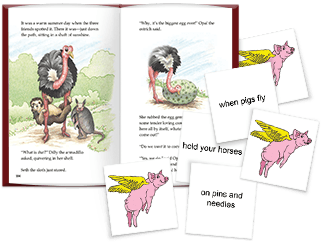
AAR Level 3 introduces twelve idioms in an activity called “When Pigs Fly.” Many of these idioms are encountered in “Chasing Henry” and subsequent stories.
Download Level 3 Activity: “When Pigs Fly”
Download Level 3 Story: “Chasing Henry”
Learn how the early bird catches the worm with this idiom activity and story from All About Reading Level 4.

Children are exposed to more idioms in a Level 4 activity called “The Early Bird Catches the Worm” and in a short story called “The Elephant in the Room.”
Download Level 4 Activity: “The Early Bird Catches the Worm”
Download Level 4 Story: “The Elephant in the Room”
60 Favorite Idioms
Many idioms have to do with animals (a little birdie told me), some have to do with color (tickled pink), and still others have to do with food (apple of my eye). Here’s a great collection of common idioms you can share with your children. Hang the list on the fridge or in your classroom, or discuss them over lunch–or even over a piece of cake!

Now that we’ve learned all about idioms and how to teach them, please share your favorite in the comments below!


Comments
No comments yet. Our team reads and replies to every one.