


Struggling with Letter Reversals?
It is easy to see how letter reversals happen: flip the b and it becomes a d. The beginning reader or dyslexic child may not realize that the direction of the letter matters, or he may not be able to remember which letter is which.
Letters that are mirror images of each other are more likely to be confused, including letters b and d, p and d, p and q, and n and u.
Fortunately, most of the letters of the alphabet have unique shapes, so no matter which way you turn them, they can’t be confused with any others. For example, the letter m looks quite different from the letter x, and f is not likely to be confused with the letter z.
What Is Considered Normal?
If your child is between the ages of three and seven, is just starting to read, and makes occasional letter reversals when reading or writing, it’s perfectly normal. It doesn’t mean that your child has dyslexia or a reading disability. Make a gentle correction and move on.
But if your child is eight years or older, has had prior reading instruction, and makes frequent reversal errors, it is important to take action to solve the letter confusion.
As reading instructors, we have two jobs to do regarding letter reversals:
- Try to prevent confusion.
- Where confusion exists, resolve it.
How to Prevent Letter Confusion Before It Begins
The All About Reading program is carefully structured to minimize the likelihood of letter reversals. We teach the sounds of potentially confusing letters like b and d in separate lessons. The child’s task is simplified because he only has to make one new visual discrimination at a time.
When your child is learning to print, be sure to teach correct letter formation. Doing so is critical to prevent confusion.
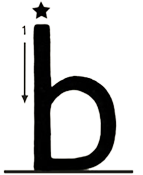
When forming the letter b, start with the stick first, followed by the circle. The star indicates the starting position.
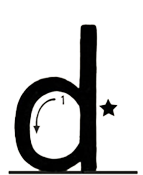
To write the letter d, start with the circle first, followed by the stick. Again, the star indicates the starting position.
Have your child use lined paper so it is clear where the circle is in relation to the stick. Also be sure your student does not lift the pencil from the paper when writing any of the confusable letters.
If Your Child Already Reverses Letters
If you are working with older learners, it may be too late to prevent confusion. They may have had a few false starts in reading, and may have already confused these troublemakers. They may encounter the letter b and misinterpret it as the letter d. They may read the word bad as dab, or fad as fab. You might give a gentle correction, pull out the corresponding Phonogram Cards, and re-teach the letters separately, but your student still mixes them up. If that is the case, read on to discover four effective methods to solve the problem.
Four Methods to Solve Tough Reversal Problems
The demonstrations below are for correcting b and d reversals (the most common letter reversals), but the same concepts can be applied to any letter or number. You may only need to use one of these methods, but for really resistant cases, you will need to use all four methods.
Please note that it’s important to concentrate on just one letter per session. Wait until that letter is completely mastered before teaching another letter.
-
Method 1: Teach the letters b and d using tactile surfaces.
Have a variety of tactile surfaces for your child to choose from. Possibilities include flannel fabric, corrugated cardboard, very fine sandpaper, fluffy fur fabric, or a carpet square. Ask him which surface reminds him of the letter b, and then cut a large lowercase b out of the chosen tactile surface.
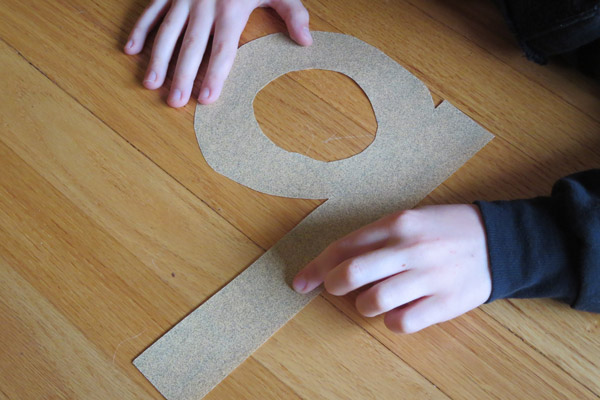
Using the pointer finger of his dominant hand, have your child trace the letter b on the textured surface. Be sure that he starts and ends in the correct place. Practice until he can easily write the letter b.
When your child is ready to go on to a new letter, choose a different textured surface. If fine sandpaper was used for the letter b, perhaps furry fabric can be used for the letter d.
-
Method 2: Use “air writing” to reinforce proper letter formation.
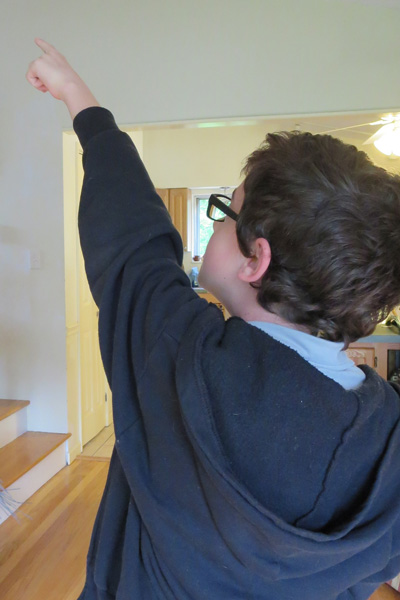
Another powerful method for correcting letter reversals is “air writing.” Air writing is simple: using the dominant hand, the child uses his entire arm to write letters in the air as he says the sound of the letter. The whole arm should be involved, and the child should pretend that his pointer finger is a pen.
Here, Jimmy demonstrates for us how to use air writing to form the letter b. Notice that his whole arm is involved in order to activate large muscles. He is pretending that his pointer finger is a pen. While he forms the letter b with his arm, he is saying the sound of the letter, /b/.
Brain research shows that two ideas practiced at the same time can permanently bond the ideas together. In this case, the large movements of the arm combined with saying the sound of the letter helps link these two concepts together in your child’s brain.
Additionally, this multisensory activity takes advantage of the fact that the muscles in the shoulder and in the jaw have muscle memory, and this makes it easier for your child to recall the shape and sound of the letter.
-
Method #3: Teach the letters b and d using analogies.
Explain that the letter b is made up of two shapes: a bat and a ball. Using the tactile surface, demonstrate how you write the bat part of the letter first, followed by the ball.
As you write the letter b, say “bat-ball-/b/,” like this:
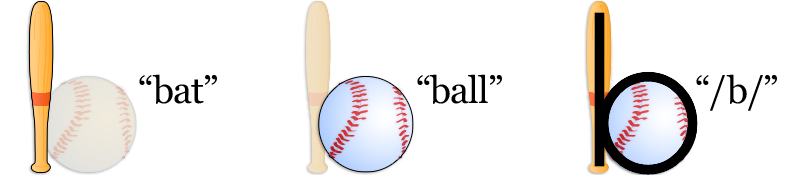
To further clarify which side of the letter the straight line is on, tell your student, First you grab the bat, then you hit the ball. Have your student practice this motion and chant many times over a two-minute time period. Show your student that when you are reading from left to right, you encounter the bat part of the letter first. If he is ever unsure of the sound this letter makes when he sees it, he should think to himself, “bat-ball-/b/.” This will help him recall the sound of the letter b. Repeat the exercise several times a day.
To teach the letter d, you can use the analogy of a doorknob and a door. The doorknob represents the circle part of the letter, and the door represents the straight line, like this:
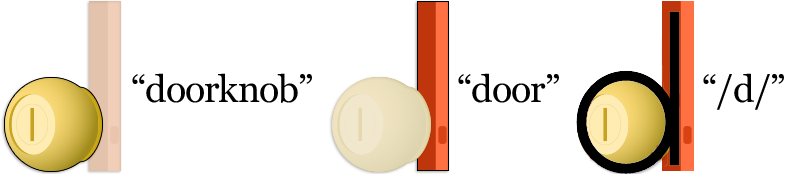
To clarify which side of the letter the straight line is on, tell your student, First you grab the doorknob, then you open the door. Again, practice the motion and chant many times over a two-minute period. Show your student that when you are reading from left to right, you encounter the doorknob part of the letter first. If he is ever unsure of the sound this letter makes when he sees it, he should think to himself, “doorknob-door-/d/.” He will now be able to recall the sound of the letter d. (Download our How to Solve Letter Reversals report for printable bat/ball and doorknob/door graphics.) Repeat the exercise several times a day.
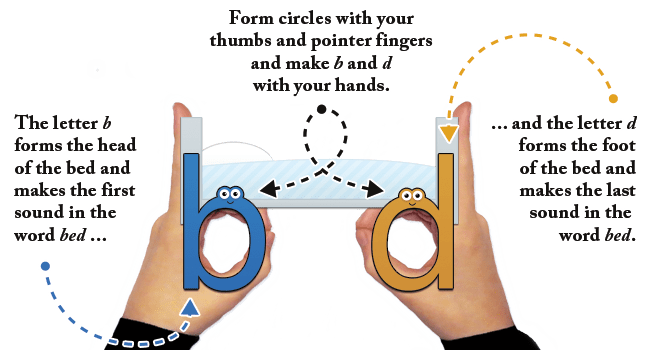
A common analogy to help with b and d confusion is a bed. Though this analogy may help some kids, for others it may require more thought, and for many kids it may not become automatic.
-
Method #4: Help your child notice the shape of our mouths while saying the letter sounds.
When we say /b/, our lips come together in a straight line. Point out that the straight line comes first when you write the letter b.
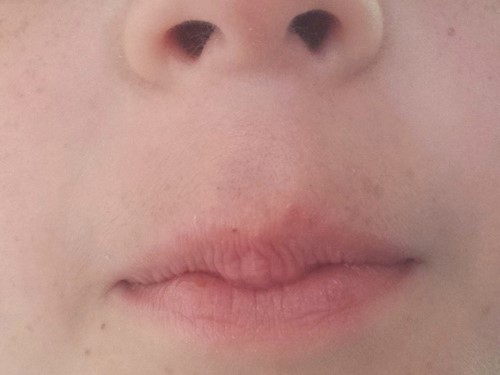
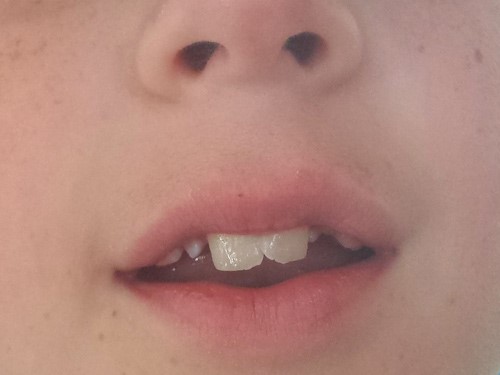
When we say /d/, our lips are open. Coincidentally, the circle comes first when you write letter d.
If Your Child Confuses b with d While Reading
If your child mistakes a b for a d while reading, refer back to the tactile surface activity and air writing that you did together. Point to the misread letter and say, If you wrote this letter, what would this letter say?
If your child can’t answer easily, ask him or her to draw the letter b using air writing. The sound of the letter (/b/- bat) should come more easily this way. Then have your child read the word again.
For More Help with Letter Reversals
This free e-book illustrates the four methods outlined here, plus it has two printable charts to help you correct b and d reversals.

When students have persistent reversals, reading becomes a struggle and it can be difficult for them to express themselves in writing. You can put an end to that struggle with the information shared in this report!
Have you discovered a helpful strategy for dealing with letter reversal issues? Please share in the comments below.


Comments
No comments yet. Our team reads and replies to every one.