


When I developed All About Reading and All About Spelling, I combined the key features of the Orton-Gillingham approach with the latest research and proven spelling rules. But why? What’s so special about Orton-Gillingham?

What Is Orton-Gillingham?
Orton-Gillingham (OG) is a powerful approach to teaching reading and spelling that uses instruction that is multisensory, sequential, incremental, cumulative, individualized, phonics-based, and explicit. Though often touted primarily as an instructional method for children with dyslexia and other learning challenges, the OG approach helps make reading and spelling easy for all children.
Who Were Orton and Gillingham?
Dr. Samuel T. Orton (1879-1948) was a pioneer in the study and understanding of dyslexia. He studied numerous children with language processing issues and eventually developed teaching principles designed to help these children learn language more effectively. One of Dr. Orton’s students, Anna Gillingham (1878-1963), further developed Orton’s ideas and eventually combined his teaching methods with her own understanding of language structure. The first Orton-Gillingham manual was published in 1935.
Why Does the Orton-Gillingham Approach Work?
The Orton-Gillingham approach helps take the mystery out of reading and spelling by focusing on why words are spelled the way they are. Though the English language contains just 26 letters, these letters combine to create approximately 44 speech sounds, and there are over 250 ways to spell those sounds. But the OG approach translates the spelling of these sounds into phonograms and demystifies reading and spelling by teaching students to apply rules and generalizations that help make what was once difficult much easier! (Click to download our Orton-Gillingham Approach poster!)

In a nutshell, Orton-Gillingham works because it …
- instills confidence;
- helps children overcome learning disorders;
- makes it easier for children to learn to read, including children with dyslexia and other learning challenges.
Are you ready to explore all the features that make the Orton-Gillingham approach so effective? Read on!
What Are the Key Features and Benefits of the OG Approach?
-
Multisensory

Multisensory instruction is the hallmark of the Orton-Gillingham approach. This technique focuses on the idea that when children learn through three major pathways to the brain—visual, auditory, and kinesthetic—they learn more than when they are taught through only one pathway. But the real power comes when you engage the senses of sight, sound, and touch all within the same lesson. So with the OG approach, you don’t have to figure out if your child has a particular learning preference because all three pathways are already built in to every lesson.
-
Sequential

When instruction is sequential, lessons are presented in a logical, well-planned sequence. This sequence allows children to make easy connections between what they already know and what they are currently learning–an important step in achieving long-term learning. And that makes learning a rewarding experience for your child.
-
Incremental

With incremental instruction, each lesson builds carefully upon the previous lesson. This helps your child move smoothly and naturally from simple concepts to more complex ones, ensuring that there are no gaps in his learning. It’s a lot like climbing a ladder: when lessons are incremental, each rung of the ladder helps your child get closer to the goal of reading and spelling. Even students who have experienced failure with other programs can learn to read and spell with this approach.
-
Cumulative

Two of the most important components of cumulative learning are mastery and constant and consistent review of previously taught skills. When instruction is cumulative, students master one concept before moving on to a more advanced concept. Those concepts are further reinforced with review that is integrated into every lesson. The goal of mastery and review is to make sure that the brain permanently stores, manages, and retrieves information for later use; in short, to achieve learning that “sticks.” When a concept is learned and mastered, the goal of long-term learning has been reached.
-
Individualized

Because everyone learns differently, the Orton-Gillingham approach is always concerned with the needs of the individual. Anna Gillingham once said, “Go as fast as you can, but as slow as you must.” Curriculum that follows this approach makes it easy for you to teach to your child’s individual strengths while at the same time respecting the child’s pace. Consequently, this approach works for all ages—beginning readers, intermediate students, teens, and adults.
-
Based on Phonograms

The Orton-Gillingham approach simplifies the English language by focusing on why words are spelled the way they are. By teaching the phonograms and the rules and patterns that spell the vast majority of English words, the OG approach takes the guesswork out of reading and spelling. When a student has a working knowledge of the phonograms and their sounds, reading and spelling are much easier. In fact, even children with reading disorders like dyslexia can overcome the language processing issues associated with these disorders.
-
Explicit

In an Orton-Gillingham reading or spelling program, students are taught exactly what they need to know in a clear and straightforward manner. Students know what they are learning and why they’re learning it. This direct instructional approach helps children master skills and gain confidence. When instruction is explicit, there is no guessing, no ambiguity, and no confusion.
All About Reading and All About Spelling make it easy to use the Orton-Gillingham approach to teach reading and spelling. Our lightly scripted, open-and-go teacher’s manuals walk you through each step—with no experience, special training, or extra prep time required by you! You will be teaching like an expert from the very first lesson, and your child will receive all the benefits of this effective method.
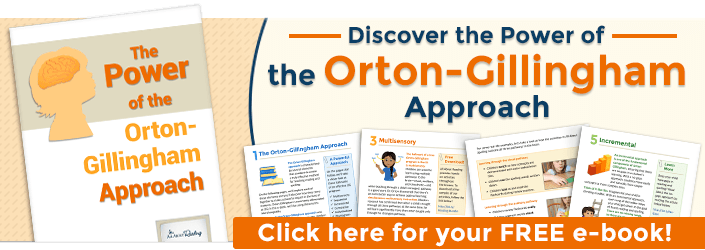
For more details, be sure to download our free e-book, The Power of the Orton-Gillingham Approach. And let us know in the comments below if you have any questions about teaching reading and spelling. We’re here to help!


Comments
No comments yet. Our team reads and replies to every one.