


Spelling lists are the foundation of many spelling programs. But when you take a closer look, you’ll see that most spelling lists don’t make sense to the student. In fact, most lists have major flaws that actually keep kids from learning to spell.
In this blog post, we’ll take a look at some common types of ineffective spelling lists. After you know what to look for, you’ll be able to spot the ineffective lists and prevent frustration for your student. And you’ll save yourself a lot of grief, too!
Common Types of Ineffective Spelling Lists
-
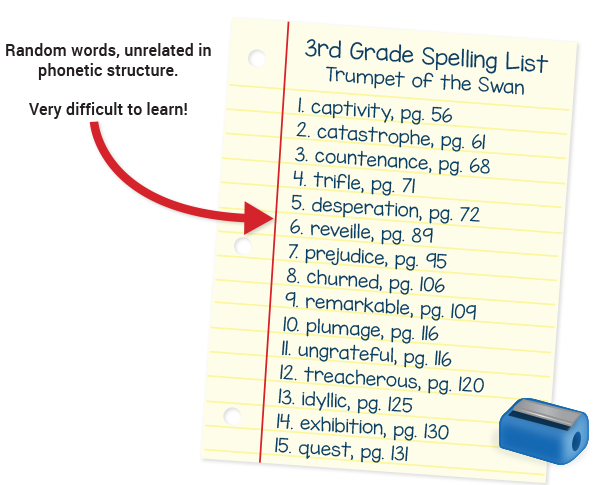
Words taken from a book the student is reading
The words on these lists are usually unrelated both in terms of content and phonetic structure. For example, this 3rd-grade spelling list from Trumpet of the Swan includes words such as catastrophe, reveille, and plumage.
-
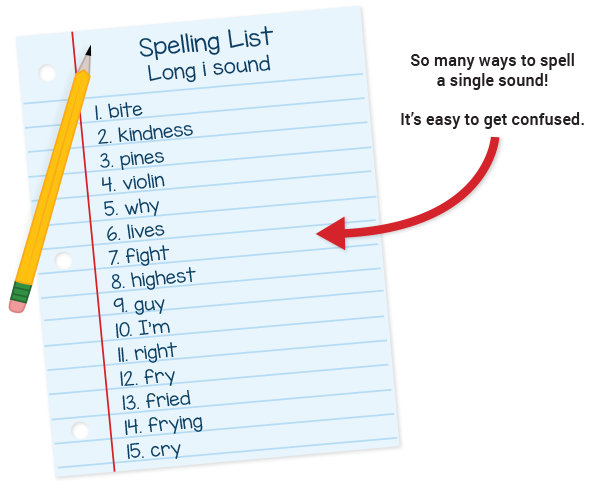
Words showing all the different ways that a single sound can be spelled
These lists can contain words with as many as six or seven different ways to spell the same sound. For example, the following list features the long I sound and includes words such as item, timed, pie, cry, light, and kindness.
-
Words taken from the Dolch or Fry lists (in frequency order)
The words on this type of spelling list are completely unrelated to each other. Seemingly random words such as hot, because, far, live, and draw, are grouped together only because they are frequently used words.
-
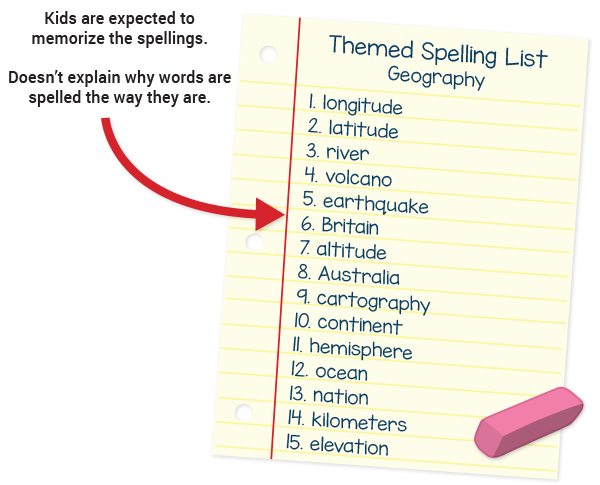
Words centered around a theme
One week the spelling list might be geography-themed and include the words longitude, Britain, and region. The next week the word list might focus on math and feature words like quotient, addition, and prime. These are all good words, but unfortunately kids are expected to memorize the spellings by rote instead of learning why the words are spelled the way they are.
Here’s the Main Problem with These Lists
All these lists make spelling much harder than it needs to be. The related phonograms and spelling rules generally aren’t explicitly or systematically taught, leaving students to figure out the code on their own or resort to guessing. Rote memorization of the words on the list is difficult (and boring). And the words are easily forgotten because there is nothing for the learner’s mind to “attach” the words to.
For many students, learning to spell with ineffective lists leads to a lifetime of poor spelling. But there’s a better way!
Spelling Lists that Do Make Sense
Here’s the good news! There is a fifth type of list that actually does make sense.
-
Word lists centered on a single, well-organized spelling concept
This is the type of list we use in the All About Spelling program.
Our lists are different. We don’t just hand the student a list on Monday and expect him to have it memorized for a test on Friday. In fact, we don’t even have tests! Instead, we teach students why words are spelled the way they are and demonstrate how all the words on the list are related to each other.
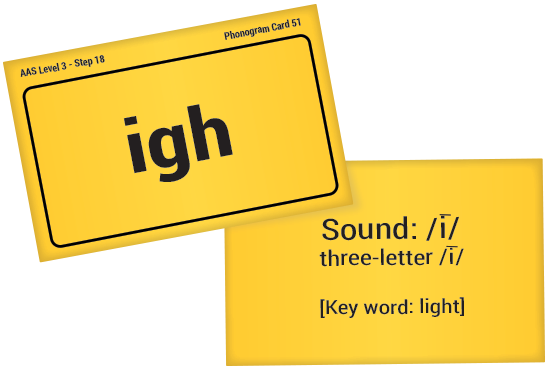
For example, when we teach the IGH phonogram (which says /ī/ as in high), we teach multiple words that contain IGH, such as:

Can you see how the words on this list reinforce the phonogram the child has learned and provides the opportunity to practice it?
Unlike the Long I list shown in list type #2, our list has reason and logic behind it and will therefore be easy for a student to remember and use for encoding new words later on.
An Emphasis on Review
After the student learns the words that contain the IGH phonogram, we review that newly learned concept in many ways.
- We review using Word Cards, being sure to mix up the new words with previously learned words.
- We dictate phrases and sentences using the new words.
- We encourage the student to write original sentences using the new words.
In all, we incorporate four major spelling strategies (phonetic, rule-based, visual, and morphemic), as well as five minor strategies. Check out this article on effective spelling strategies to learn more.
We do whatever it takes to make learning stick, which is the exact opposite of what happens with the “list on Monday, test on Friday” approach.
When you use spelling lists that make sense, it’s a win-win. Your child gets the type of teaching he deserves, and you get the satisfaction of watching him become a happy, successful speller.
Has your child ever been given a spelling list that didn’t make sense? Please share in the comments below.


Comments
No comments yet. Our team reads and replies to every one.