


What Is Phonological Awareness?
It’s a big term, but it’s really quite basic: phonological awareness is the ability to hear and identify the various sounds in spoken words.
Kids who have strong phonological awareness can do things like rhyme, count syllables, and blend sounds into words. And most important of all, kids with strong phonological awareness learn to read much more easily, making their first attempts at reading more successful. This early advantage sticks with kids as they continue through their school career.
Phonological awareness is so incredibly important that it is one of the Big Five Skills for pre-readers, and it’s one of the first things I work on with children before teaching them to read.
How Phonological Awareness Develops
Kids don’t just pop out of the womb ready to run (although with some kids it may feel that way!). Instead, babies learn to stretch their little limbs, turn over onto their bellies, crawl, and walk–and then, eventually, they are off and running.
In the same way, phonological awareness develops gradually over time. Kids start with the easiest skills–like understanding that spoken language contains words–and then move on to skills like rhyming. Eventually they develop more advanced skills like manipulating sounds and are able to play word games like “Go Find It.”
Quick Check for Phonological Awareness
Here are six skills that indicate that your child is phonologically aware.

Your child is able to rhyme. If you say the word bat, your child can respond with words that rhyme like hat, sat, mat, or flat.

Your child understands word boundaries. If you say the sentence Don’t let the cat out, your child is able to separate the sentence into five individual words.

Your child can clap syllables. If you say dog, your child knows to clap once. If you say umbrella, your child knows to clap three times.
Your child can blend sounds to make a word. If you say the sounds sh…eep, your child can respond and say the word sheep.
Your child can identify the beginning sound in a word. If you ask your child to say the first sound in pig, your child is able to respond with the sound /p/.
Your child can identify the ending sound in a word. If you ask your child to say the last sound in the word jam, your child is able to respond with the sound /m/.
Of course there are more advanced phonological skills, such as segmenting and sound manipulation, but the skills above are the important ones to have before beginning reading instruction.

6 Fun Ways to Develop Phonological Awareness!
If your child hasn’t yet acquired the skills on the checklist above, you can help her develop them through informal activities such as listening to great books and playing oral language games. Here are a few ideas for you!

Help your child hear the first sound in a word with our free “Go Find It” game.
This engaging phonological awareness activity is a great way to help your child learn to identify the beginning sound in a spoken word.

Read lots of great rhyming picture books!
Head to your local library with our free Rhyming Picture Books Library List and Nursery Rhymes Library List and read a few favorites with your preschooler.

Play “Help the Monkeys” to help your child learn how to count syllables.
And visit Fun Ways to Count Syllables to read a blog post loaded with hands-on tips for teaching children this critical reading skill.

Discover five ways to teach rhyming to your preschooler.
In addition to finding lots of great teaching tips, you can also download three sample rhyming lessons from the All About Reading Pre-reading program.

Practice word boundaries with building blocks.
Say a sentence such as My puppy has long ears. Have your child build a tower by adding one block for each spoken word.

Practice sound substitution with our free “Dinner Time” game.
In addition to helping kids practice sound substitution and rhyming, this fun game will provide lots of giggles for kids and parents alike!
The majority of a young child’s day should be filled with play, real-life activities, and physical exploration. Add in just a touch of daily intentional instruction in the five reading readiness areas (including phonological awareness), and your child will have a huge advantage when it comes time to read.
Phonological Awareness Is One of the Big Five Skills
Phonological awareness is one of the five critical skills for reading readiness that we call the “Big Five Skills.” The other four skills are:
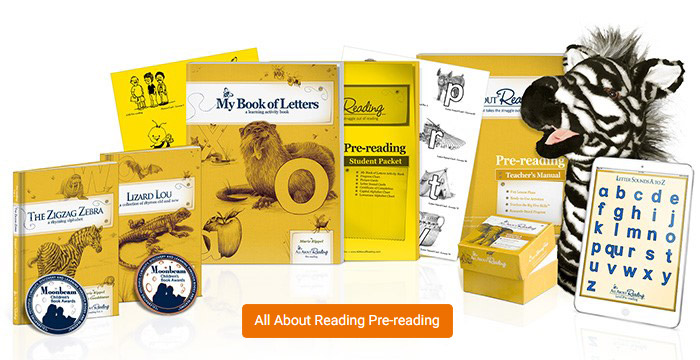
If you’re ready to tackle the rest of the Big Five Skills, be sure to check out the All About Reading Pre-reading program. Your student will enjoy special games, crafts, and story time read-alouds, and you will love the way your student effortlessly learns essential pre-reading skills.
Do you have any questions about print awareness? Post in the comments below!


Comments
No comments yet. Our team reads and replies to every one.