


It can be challenging for young readers to read at the right pace. Some kids read too slowly, while others read too fast.
Reading too fast may seem like a somewhat unlikely problem. Having a child who reads too slowly can throw up obvious red flags, but parents and teachers aren’t always as concerned when a child reads too quickly.
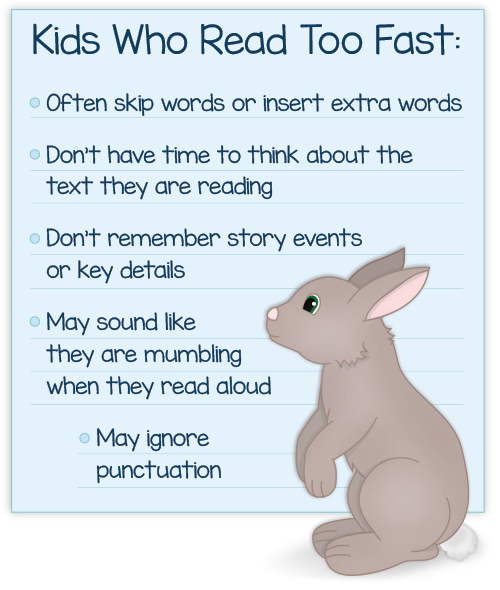
There are some definite problems with reading too fast, though.
Children who read too quickly tend to think that “good readers are fast readers.” Listen to the example in the video below. What do you think—does this sound like good reading to you?
As you can imagine, it’s important for students like this to slow down so they can read accurately and comprehend the text. So let’s move on to the solutions!

10 Ways to Help a Child Who Reads Too Quickly
- Explain that reading should be at the same pace as regular talking—not too fast and not too slow.
- Read a paragraph aloud to her twice and ask her to tell you which one is easier to understand. The first time, read it extremely fast with no expression and without stopping at punctuation. The second time, read with meaningful expression at a normal, understandable pace. Can she hear the difference? Was one easier for her to understand?
- Acknowledge that she’s a good reader and can read very fast, but that you want her to slow down when she reads because you want to understand the words she is saying.
- Record your student reading at a fast pace and then at a regular pace. She can listen to the recordings to hear the difference.
- Instead of asking your student to point to each word, try having her use a piece of paper as a guide under the line she is currently reading. See if the physical reminder of a piece of paper—and the act of having to move it as she reads—helps her slow down.
- You could have a code phrase to remind her to slow down, such as “speedy bunny.”

- Read a page to her at a normal pace, and then have her read it at her fast speed. See if she can hear the difference. Then read the next page to her, and have her match your reading pace.
- If your child ignores punctuation, teach her to pinch her fingers together when she hits punctuation at the end of sentences. This is a good kinesthetic reminder to slow down for punctuation.
- You can also try assigning a shorter amount of reading. Start with whatever amount she can cheerfully read at a good pace—then end there. Praise her for reading at an understandable pace or with expression, or for any part of her reading that went well. It may be that she looks at the length of reading and just wants it to be over fast, so focusing on a shorter passage done with expression will reinforce the right habits.
- Try buddy reading. By taking turns reading each page of a story, you have the opportunity to demonstrate proper pacing for your child to emulate.
Remember that child who reads too fast? Listen to what a difference it makes when that same child slows down to a normal pace.
How about you? Does your child read too fast? Have you discovered any helpful tips?


Comments
No comments yet. Our team reads and replies to every one.