


Closed and open syllables are the first two syllable types students should learn. Out of the six syllable types, these two are the easiest for students to master.
What Is a Closed Syllable?
In its simplest form, a closed syllable is a vowel followed by a consonant. Examples include cap, sit, and up.
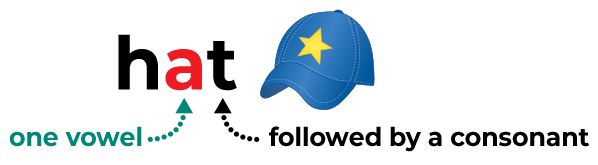
It’s called a closed syllable because the vowel is “closed in” by a consonant. In closed syllables, the vowel usually says its short sound.
More than one consonant can be used to close in a syllable, as in dish and stretch. And many multisyllable words contain closed syllables, as in insect, rabbit, and napkin.
What Is an Open Syllable?
An open syllable has a vowel at the end of the syllable. Nothing comes after the vowel, as in no, my, and we.
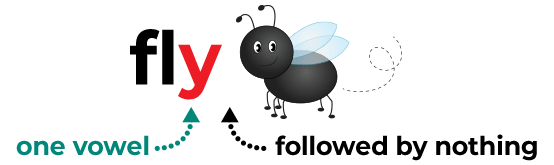
It’s called an open syllable because the vowel is “open”—that is, nothing comes after it except open space. In open syllables, the vowel says its long sound.
There aren’t many one-syllable words that contain open syllables, but there are many multisyllable words that do. For example, look at the first syllables in these words:
ba by
e ven
pa per
mu sic
Why Is Knowing the Syllable Types So Beneficial?
Knowledge of syllable types is an important decoding tool for both reading and spelling.
Let’s say a student is reading a story and she comes across the word craft. She doesn’t instantly recognize the word because she has never read it before. Although the word is unfamiliar, she isn’t flustered because she has a method for determining whether the letter A says its long or short sound. She sees that the A is followed by a consonant, which means that it is in a closed syllable, so the vowel most likely says its short sound. She is able to decode the word craft independently and continues reading the story.
Syllable type knowledge helps with spelling, too. In the scenario below, the child wants to spell the word kitten. But she hasn’t reached the stage of automaticity yet, so she can’t remember whether there is one T or two in the middle of the word.
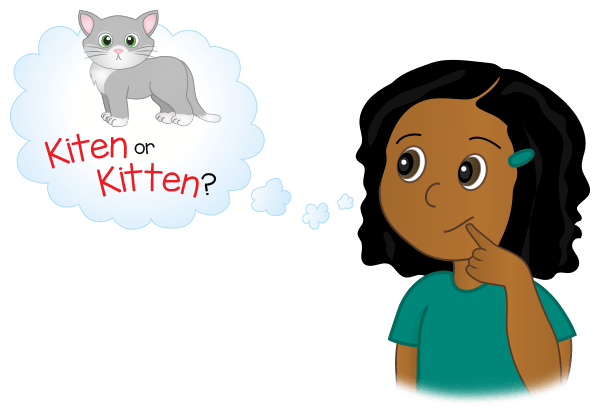
A child who doesn’t have a visual picture of the word and doesn’t know about syllable types might just write the word as kiten. After all, we pronounce it “ki(t) ten,” without enunciating the first T.
But our student can draw upon her knowledge of open and closed syllable types and easily come up with the correct spelling.
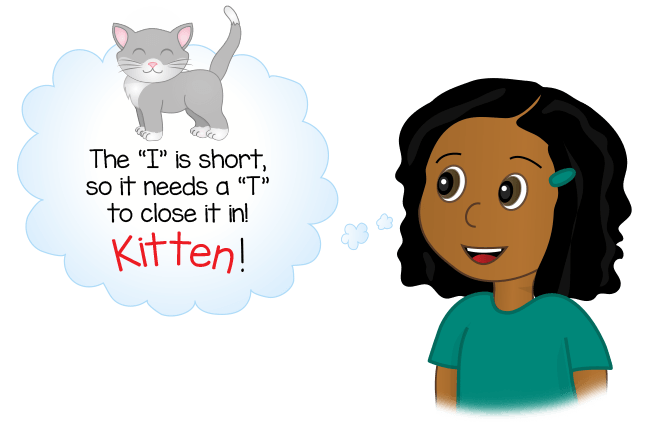
Our student realizes that if she leaves the first vowel open, it will say its long sound, resulting in /kī-těn/. (There are some exceptions such as city where the vowel is left open yet still says its short sound, but these words are the exception rather than the rule. And in the All About Spelling program, we give kids tools to help them spell these exceptions.)
Teaching Open and Closed Syllables
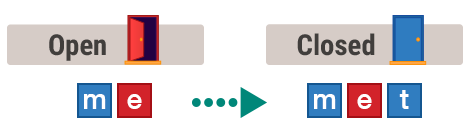
In the All About Reading and All About Spelling programs, we use the letter tiles app (or the physical letter tiles) to demonstrate the differences between open and closed syllables (and all syllable types!). Syllable tags are placed above words, making this a concrete activity. An open door represents an open syllable, and a closed door represents a closed syllable.
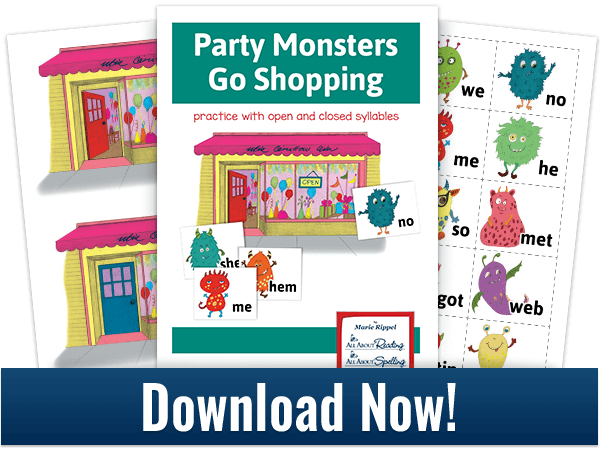
In the All About Reading program, fun characters known as Party Monsters pitch in to give kids even more practice with open and closed syllables. Give it a try with this free download!
Knowing just these two types of syllables will enable your student to accurately spell hundreds of words!
For even more great samples, feel free to visit our Reading and Spelling Lesson Samples page. You’ll find hundreds of pages of downloadable PDFs that are packed with information.
Do you have questions about open and closed syllable types? Ask in the comments below or get in touch! We’re here to help.


Comments
No comments yet. Our team reads and replies to every one.