


Did you know that your child can have 20/20 vision yet still have trouble reading text?

Undiagnosed vision problems are quite common. In fact, experts1 estimate that 1 in 10 children has a vision issue that affects learning. Here at All About Learning Press, parents regularly share stories with us that prompt us to suggest vision testing.
Elizabeth Bird* is an All About Spelling user who discovered that her child had vision problems, in addition to several other significant developmental differences. Her hope is that their story will help other families find the help they need, so they won’t have to go through what she and her son have gone through!
Here’s Elizabeth…
My childhood was a treasure trove of tales. I was resolved to raise readers, so I continued down the path my parents had paved by reading aloud to my son even before he was born.
As a toddler, my son had a vast vocabulary. He loved long words, like micropachycephalosaurus, yet he didn’t speak in intelligible sentences. Over time, he was diagnosed with auditory processing disorder, sensory integration disorders, dyspraxia, and autism. But that wasn’t all. When he began to read and spell simple CVC words, I noticed that it was a monumental effort for him to focus on the page. During fleeting moments of focus, he’d read long words but skip short words, and sometimes skip entire rows of text.
I also noticed that my son would avoid eye contact, glance out of the corner of his eye, and hold his head while running. His vision screenings showed that he had 20/20 vison, so these behaviors were all dismissed as symptoms of his other diagnoses. My son couldn’t describe the vision difficulties he was experiencing because he didn’t realize they weren’t normal. But one day, in despair, he admitted that the “wobbling words” hurt his brain. That was a breakthrough for us!
We went to a board certified developmental optometrist, whose comprehensive assessment revealed a visual processing disorder. My son thinks in pictures, yet everything he saw for the first decade of his life was distorted and confined to a 10% functional visual field. That he had learned to read at all was a testament to his courage and perseverance. On one hand, it was frustrating to receive yet another diagnosis. But as it turned out, this was the most encouraging diagnosis we received because vision therapy fully remediated his vision and transformed his life!

Vision therapy was intensive, but just understanding the problem brought relief. For nine months, a vision therapist worked with my son for 45 minutes once a week, after which I received 15 minutes of instruction and obtained tools necessary for homework. Each week there were new exercises, and we worked on those exercises at home five days a week. We rested on Sundays.
I will never forget the thrilling moment when, closely observing my son’s eyes during a challenging exercise, I witnessed neuroplasticity in action— his brain and eyes were working harmoniously! His joy made mine complete, and it made our arduous effort worthwhile.

Vision therapy transformed every aspect of his life. Social situations are less confusing. Grocery shopping is not as overwhelming. Mathematics and reading and writing have all improved as text remains in focus and in place. Integrated reflexes, good peripheral vision, and clear targets contribute to greater proficiency and enjoyment of physical activities. Today, our son is an avid reader who reads to his brother daily and helps him with his reading.
During the demanding process, All About Spelling integrated well with vision therapy, enabling us to progress academically without placing undue stress on his brain or nervous system. This would not have been the case with traditional teaching methods.

If you are using All About Reading or All About Spelling, yet your child is still having trouble, please don’t give up. There is hope, even for older students, since neuroplasticity continues even after ten years of age.
I wish all children could have a comprehensive vision assessment prior to schooling, and I strongly urge you to investigate this frequently hidden problem.
“Good reading becomes possible when you need not consciously think about eyes, or light, or print, or spelling.” –C.S. Lewis
An Update from Elizabeth
Elizabeth recently sent us an exciting update about her son’s progress and it made our day! For all of us here at All About Learning Press, moments like these are exactly why we do what we do!
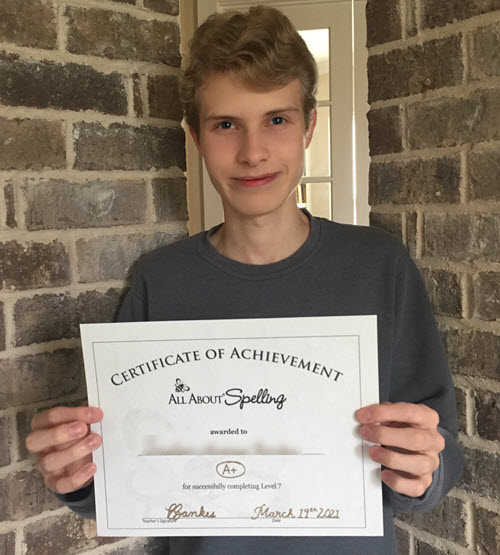
Thanks to Marie’s excellent curriculum & my son’s determination, he has graduated from All About Spelling! Please, go ahead & shout it from the rooftops! Loud applause for Marie!
Vision-related websites that were helpful to Elizabeth
- College of Optometrists in Vision Development
- Vision Therapy Success Stories
- The Center for Vision Development, Inc.
- The Center for Vision (Website links related to eye care)
- Vision and Learning (YouTube video)
- Convergence Insufficiency (YouTube video)
- Convergence Insufficiency Test (YouTube video)
- Fixing My Gaze by Susan R. Barry
Products Elizabeth used with her son during vision therapy
An All About Reading user with vision issues
Did you enjoy Elizabeth’s story? Read more stories from Real Moms and Real Kids.
Do you suspect vision problems with your child? What are the symptoms?
1College of Optometrists in Vision Development. (n.d.) ADD/ADHD & Vision. Retrieved from https://www.covd.org/
_________________________
*To preserve the privacy of the child featured in this story, we did not use the family’s real names.


Comments
No comments yet. Our team reads and replies to every one.