


Have you ever wondered what’s involved in a typical week with AAS?
Cassandra Ginter and Merry Marinello are real moms who use All About Reading and All About Spelling with their own kids. They are both also part of our Customer Care team, where their hands-on experience puts them in a great position to help other parents unlock the power of AAR and AAS.
We asked Cassandra and Merry to share their routines for using AAS in their homes, and they even provided some fantastic tips for added enjoyment, ease, and effectiveness. Join Cassandra as she takes us through a week with her eight-year-old student, currently using the Level 2 Color Edition, and then read about a typical week for Merry and her teen student as they progress through Level 6.
Here’s Cassandra…
We have been committed All About Reading and All About Spelling fans in our home from the beginning of our homeschooling journey, and now I have the absolute joy of working for AALP and helping other families! We were incredibly excited for the color edition of AAS since first hearing about it, and now that it’s been released, it has not disappointed us!
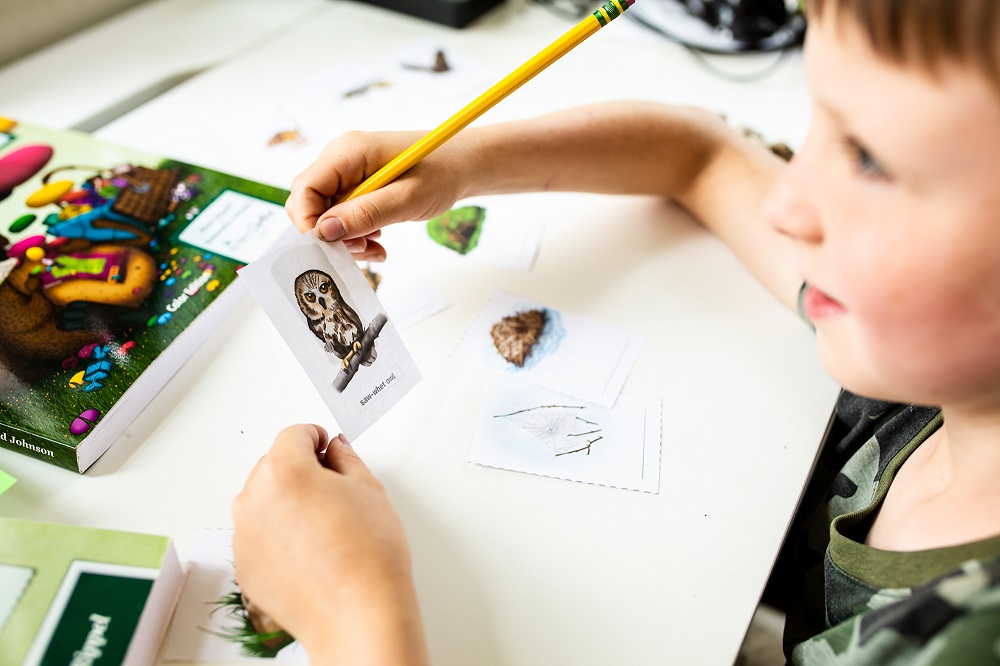
My eight-year-old son is on Lesson 10 of All About Spelling Level 2 Color Edition. We actually began Level 2 with the black-and-white edition and then made the switch to color when it was released. The transition was completely seamless!
My son has always been a struggling speller (suspected dyslexia), and while spelling is still not his favorite subject, he has made consistent forward progress. Because of his dyslexia, we’re moving through spelling at a slower pace than some kiddos might. Each lesson takes about a week—sometimes more—to complete, and we build in extra review days pretty frequently (kiddos with dyslexia tend to need a lot more repetition and review).
Here’s what our week typically looks like with AAS.
Lesson Structure
Daily Review
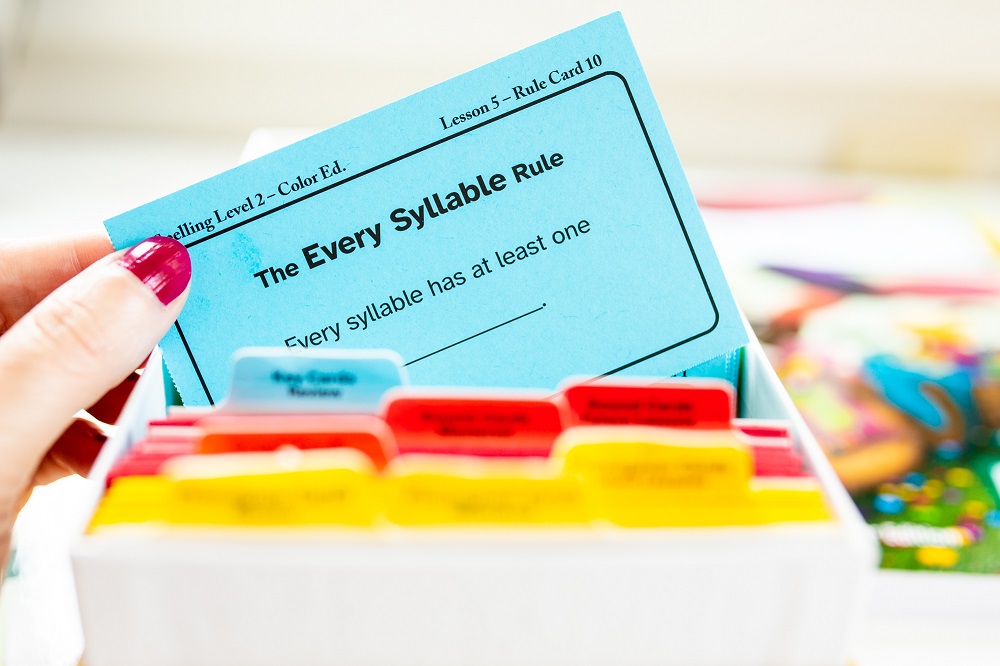
We always begin and end our lessons with a few minutes of review. We review the Phonogram and Sound Cards first, and then we do a quick review of the Rule Cards (formerly Key Cards) before starting the lesson’s new teaching or practice portion.
New Content
After we review for a few minutes, we begin the lesson.
Mondays: New Teaching
I follow the script in the Teacher’s Manual, so there’s no guesswork about how to explain a rule or concept to my son. I introduce the new concept, demonstrate it with the Letter Tiles, and then have my son teach it back to me and practice what I just taught. On Mondays, we typically don’t do any writing as all of our practice is with the tiles.
Tuesdays, Wednesdays, and Thursdays: Practice and Dictation
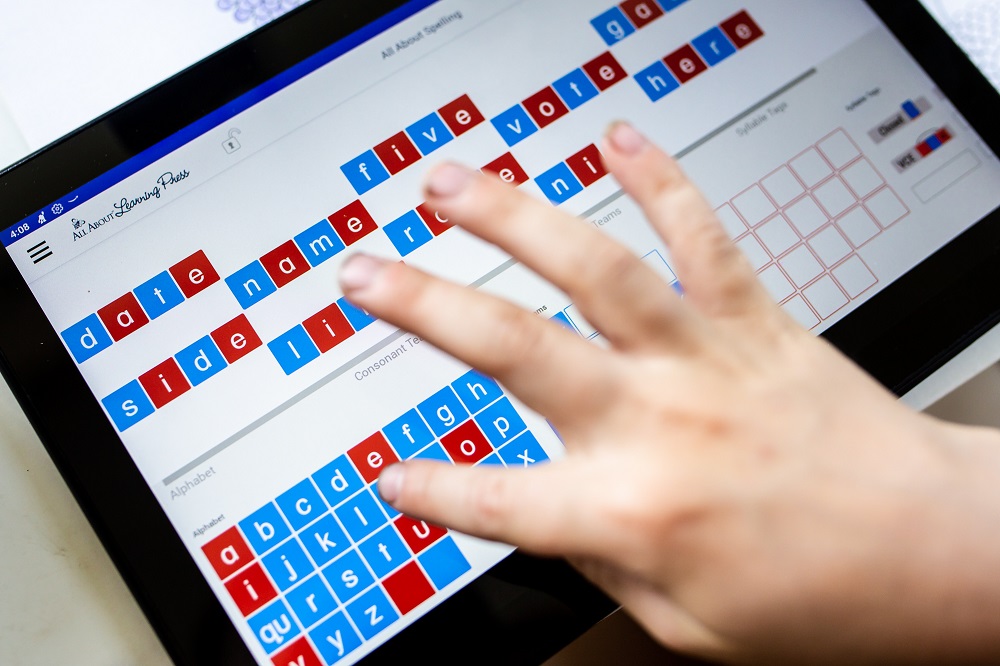
On Tuesdays my son begins writing in his dictation notebook (we use the printable Dictation Sheets for AAS Level 2 Color Edition, and I bound them into a spiral notebook for him). This continues on Wednesdays and Thursdays as well. We often use the Letter Tiles app to practice a lot of the reinforcement words to avoid the fatigue he gets from writing. However, he always handwrites the phrases and sentences in his notebook.
Honestly, this is probably the hardest part of AAS for my son, as writing really wears him out. That’s one reason I’m so thankful for the gentle way the dictation exercises start with just a few words and gradually increase, allowing him to build his stamina.
Fridays: Review and Activity Day!
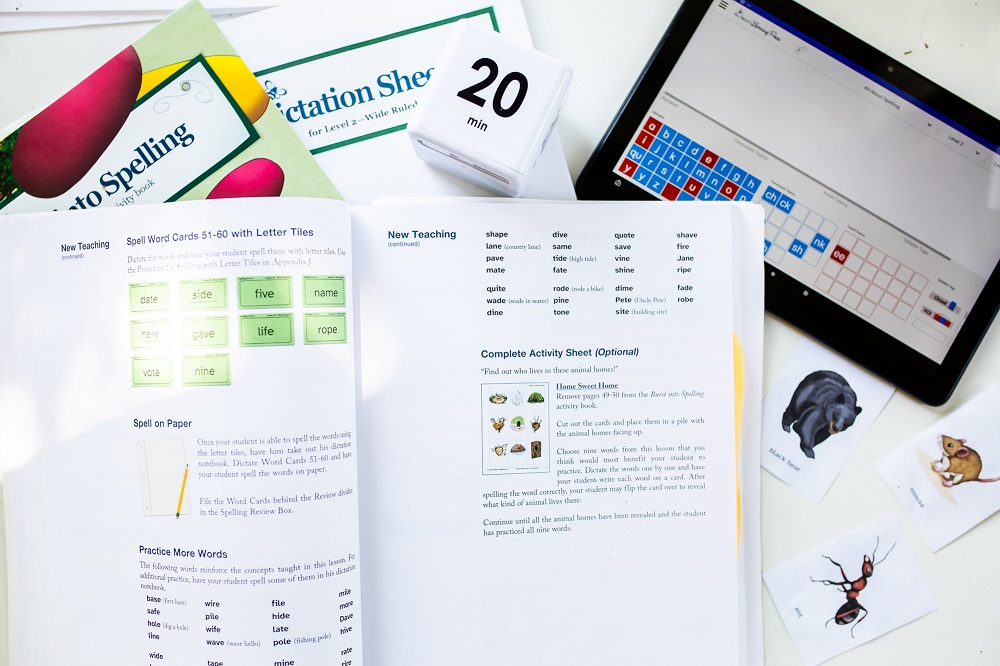
On Fridays we finish up any remaining words and/or sentences that my son didn’t get done throughout the week. Then we do the activity that goes along with the lesson. This has by far been his favorite thing about AAS! It makes the review a lot of fun and ends our week with spelling on a high note.

Note: This is slightly out of order from how the Teacher’s Manual lays out the lessons. In the TM, the activities are slated to come before dictating the phrases and sentences. However, we decided to move the activities to Fridays so that we could use them as a fun cumulative review at the end of each week.
Daily Review
Once we’ve finished the teaching/practice portion of the lesson, we spend the last few minutes each day reviewing any Word Cards that are still behind the “review” tab in his review box. I usually mix in a couple of cards from his “mastered” tab, too, just to make sure it’s still truly mastered! We do all of this review using the Letter Tiles, again, to reduce fatigue and keep him engaged in the review (except on Fridays, when this is part of the activity).
And that’s our week with the new Color Edition of AAS!
A Few Tips for Using the Color Edition of AAS
- Storage: The Color Edition has more components than the black-and-white version, so figuring out a great storage solution is key to smooth lessons. We use a rolling cart to store our daily homeschool supplies, so everything I need for AAS is right on the cart, which I wheel over to our homeschool table at the start of each day. That makes it super easy to grab what I’ll need on that particular day. But even if your storage setup is different, I would still recommend having a bin or basket that you can keep all of your AAS supplies in, so they’re quick and easy to grab when starting your lessons.
- Set a Timer: We use and love our cube timers for all of our lessons throughout our school day, and this is especially true for subjects such as spelling when that 20-minute limit is pretty important to reduce fatigue and burnout for your students.
- Pre-Cut Activities: I haven’t prepped the Color Edition of AAS in the same way I always prep AAR; however, I do pre-cut the activity sheets prior to our lessons on Fridays (or sometimes I cut them out while he’s finishing his dictation sentences). It saves valuable time during the lesson and allows us to transition from one activity to another seamlessly.
- Letter Tiles: Keep your letter tiles set up or your tablet charged. We use the Letter Tiles app, so I charge our school tablet every Sunday night to make sure we don’t have any issues with a dead battery during the week. If you use the physical letter tiles, though, you’ll want to follow the instructions in the teacher’s manual for setting up your board so that it’s always ready for your lessons. This also saves valuable time.
- Review, Review, Review: This was something that I honestly overlooked when starting AAS. At the time, we didn’t know my son had dyslexia. I knew reviewing was important, but I cannot stress enough how important daily systematic review is to the success of this program, especially if your child struggles with spelling at all!
- Have Fun! Like many subjects, spelling has the potential to be a really dry, boring subject or a really fun one with a lot of activities and games. The color edition of AAS certainly makes it easier to make spelling fun, but there are plenty of other ways, too!
- We love to include Ziggy in our spelling lessons. He dictates the words, phrases, and sentences, sometimes in silly voices and different accents.
- We also love to take spelling lessons outside and write our words on the sidewalk with chalk, on the front windows with window markers, or on the sidewalk using water and a paintbrush.
- We’ve also utilized sand trays and, of course, the letter tiles.
Kids learn best when they’re having fun, so I encourage you to think outside the box and make spelling as fun and interesting as possible!
Here’s Merry…
As a Customer Care rep for All About Learning Press, I think I have one of the best jobs in the world — talking to other moms about teaching their kids how to read and spell.
Moms often ask me what a typical day with AAS is like. I thought it might be helpful to show how we used All About Spelling in our homeschool and our typical lessons!
Here’s my son when he was in Level 6. A step (lesson) usually took us a week to complete. (In the early days, a step often took only 1-3 days. We went through Level 1 in about three weeks because my kids were older and already had all the words memorized — they just needed to learn the concepts.)
Here’s how we would divide up our week.
Lesson Structure
Day 1: Review and New Teaching
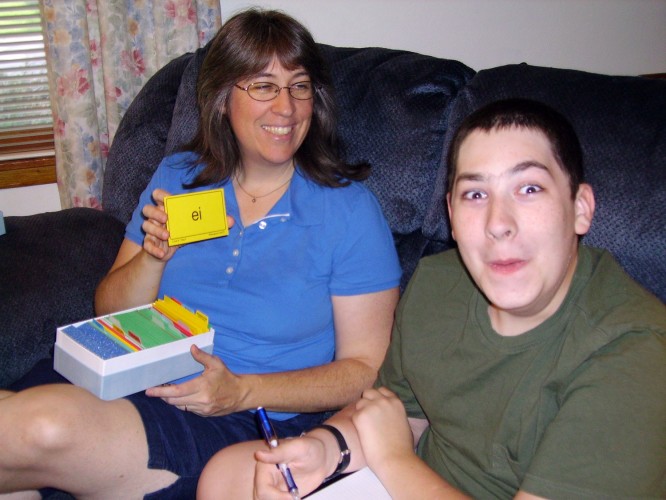
I actually set a timer for the lessons: 15 minutes for my seventh grader and 20 minutes for my ninth grader. Each day started with 2-5 minutes of review. Here I am trying to review the Phonogram Cards with my jokester.
After the review, we began the New Teaching section. This section is scripted, so I knew immediately how to demonstrate new concepts with the letter tiles on the magnet board.
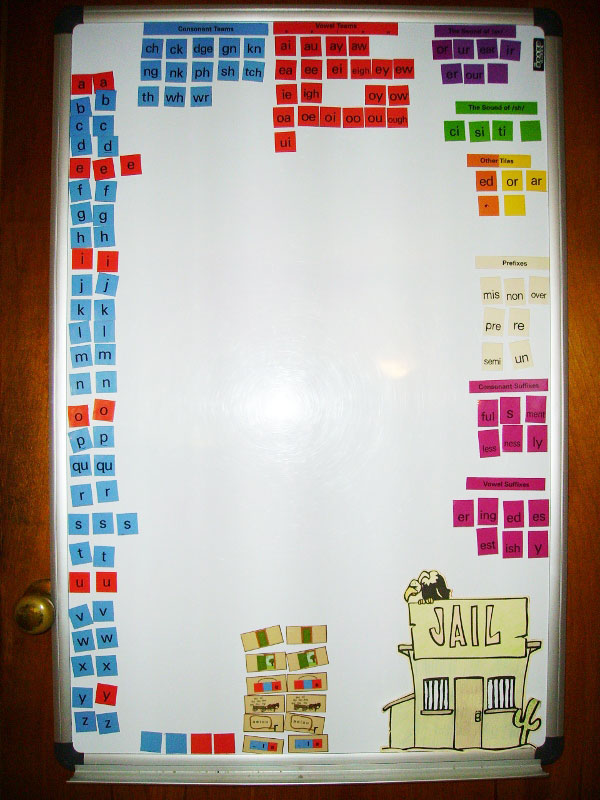
When my kids were younger, we set the magnet board against the wall or couch because I didn’t have room to hang it in our school area. After the first year, I realized I could reorient the tiles vertically, so I hung the magnet board on a nearby closet door.
Day 2: New Spelling Words
I would make sure that the new material we covered the previous day was totally understood, and we did our 2-5 minutes of review. Then it was time to meet the ten new spelling words.
I dictated the new spelling words and several sentences that contained the spelling words. After the dictation, I put the new Word Cards behind the Daily Review tab in the Spelling Review Box so we could review them the next day.
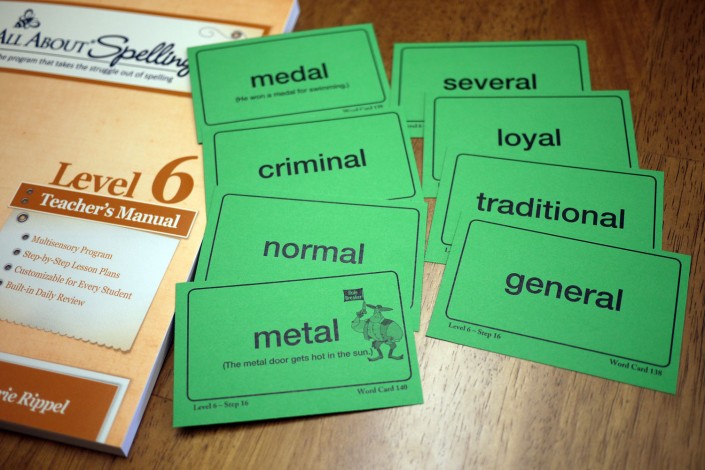
All About Spelling has a philosophy of “we don’t just teach it and forget it,” which I totally appreciate. I mean, after I put in the time to teach my kids something, I wanted to make sure that they remembered it later, and that’s where the built-in review really helps.
Day 3: Reinforcement
We reviewed older flashcards with just a couple of the new ones mixed in, because I liked to spread the new ones out over a few days. Then we quickly reviewed the new concept we’d been studying, followed by reinforcement words from the More Words section and more of the dictation exercises. If my kids missed any of the reinforcement words, I made Word Cards for them and put them behind the Daily Review tab.
Day 4: Writing Station
Here’s where we fit in the Writing Station activity (which starts in Level 3 of the program).
In the Writing Station, students make up their own sentences with words that are dictated to them. Sometimes my kids liked to make a little story using the words, sometimes they tried to be funny, and sometimes they tried to squeeze all the words into just one sentence! Here’s one that my daughter wrote:
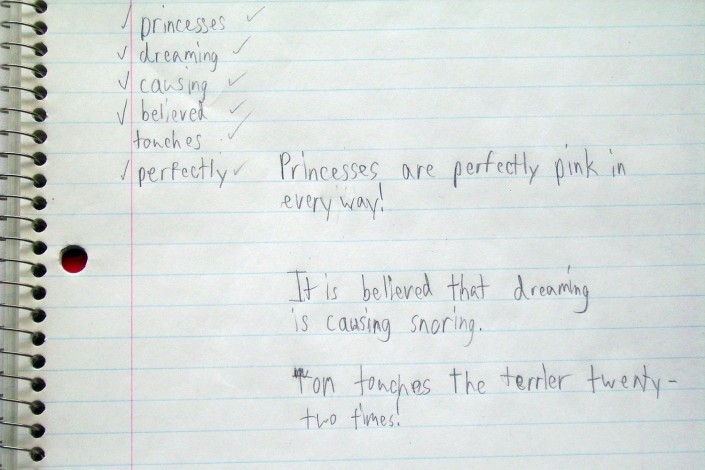
This exercise makes a nice bridge between dictation and longer writing assignments that kids will do outside of spelling. I love how AAS gradually prepares kids for writing.
Day 5: Wrapping Things Up
Whatever we didn’t get done on Days 1-4, we completed on Day 5.
If my children misspelled words in the dictation exercises during the week, I tucked those Word Cards behind the Review divider. If any concept needed to be re-taught, I did that before we moved on to the next step of the program. All About Spelling is mastery-based, so if my kids were confused about something, we fixed it before moving ahead to the next lesson.
So that’s our typical week with All About Spelling. You may go faster or slower depending on your child’s needs and ability…and that’s the beauty of using a fully customizable program!
Here’s What I Love about Merry’s Story
- Merry’s daily review time was short but consistent.
- Merry created her own Word Cards so her kids could master the reinforcement words.
- She and her children had fun, which makes dictation practice more palatable!
- Merry’s focus was mastery—she understood that it’s vital for kids to understand a concept before moving on to something new.
Did you enjoy Cassandra’s and Merry’s stories? Read more stories in our Real Moms, Real Kids series.
What about you? What elements from Cassandra’s and Merry’s routines are you eager to try? Do you have any fantastic tips of your own to share? Let us (and all the other parents and teachers) know in the comments below!


Comments
No comments yet. Our team reads and replies to every one.