


Whether your child has finished formal spelling instruction or you are just looking forward to that glorious day, this post will give you plenty of ideas of “what to do next.”
The first thing to do is to send me a note. Seriously! I love to hear from students who have completed the All About Spelling series (like our friend Josiah here).
Then after the high-fives and celebrating are over, you’re bound to ask the question,
Is that it? Does my child need to learn how to
spell any more words? Or are we completely done?
Pretend that the graphic below represents all the words in the English language. “Known Words,” represented by the inner circle, are those that your child can spell.
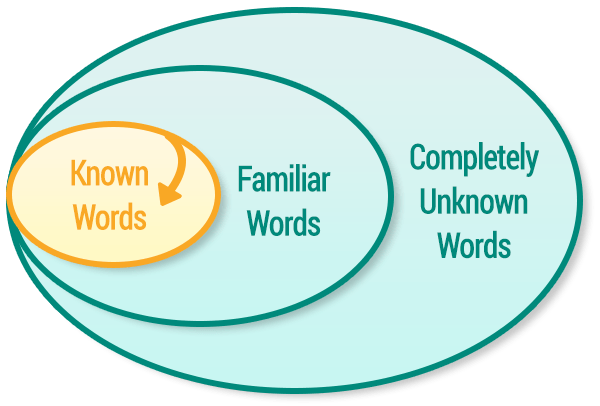
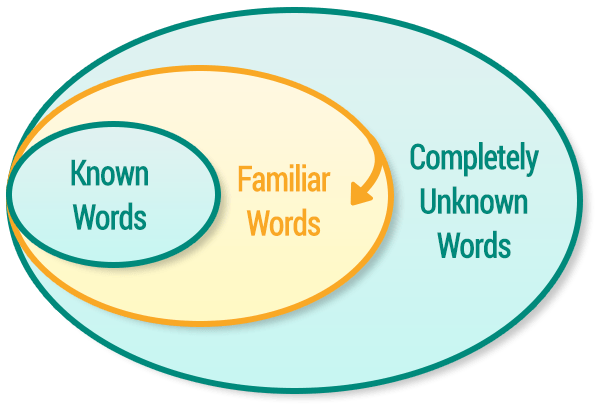
“Familiar Words” are those that are in his vocabulary, either his speaking vocabulary or his reading vocabulary. He knows what the words mean, but he’s never spelled them.
And then there are “Completely Unknown Words”—words that your child has never heard before or has never encountered in his reading.
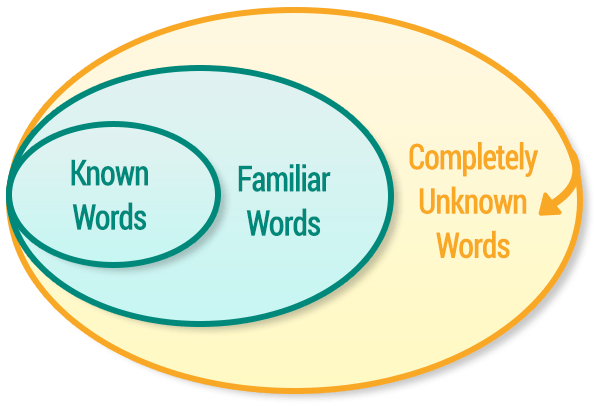
After completing the spelling program, your student will be able to spell at the high school level. But, obviously, there are many more words in the world! So I recommend that your child continue a self-directed, informal study of “Familiar Words.” These are the words that are found in the middle zone of the graphic. They are words that your child is more likely to see in print or to use in his own writing—which means that the words will be easier to learn and your child will be more motivated to learn them.
How to Find New Words to Learn
For years I kept a stash of index cards wherever I was likely to run across new words—next to a favorite reading chair, next to the computer, on the nightstand, or in a backpack—and I encourage students to do the same. When they come across a word that would be helpful to know how to spell, they can jot it down on an index card. If there isn’t a written example of the word, they should just spell the word as best they can and then verify the spelling later.
Here are some places your student can look for those new-yet-familiar words to learn:
- Books, newspapers, magazines: Encourage your student to be aware of words he reads that he isn’t sure he knows how to spell.
- Hobbies and interests: Many of the terms related to hobbies could present opportunities to explore the spelling of new words.
- Personal writing: We all run into words while we’re writing that we aren’t sure how to spell.
- Vocabulary words: If your child is studying vocabulary, those words can be added to the list.
After discovering new words to learn to spell, it’s time to analyse those words.
How and Why We Analyze New Spelling Words
After discovering new words to learn to spell, it’s time to analyze those words.
Students who have completed All About Spelling Level 7 are generally amazing at analyzing new words. After all, they’ve repeated the procedure for many lessons, gradually increasing the scope of the word analysis. But if you are new to the program, you may be wondering how to analyze spelling words.
Your child should begin the word analysis by dividing the word into syllables, then circling any part of the word that doesn’t say what he expects it to say. Then he should evaluate the word. Does the word end with a doubled consonant? He should ask himself why. Does the word end in Silent E? He should consider the jobs of Silent E and ask himself which job Silent E is performing in this word. Consider the syllable types that make up the word. By analyzing the new words, your child will be able to keep previously learned concepts fresh in his mind for future reference.
Also, by this point, graduates of the program know how to treat words like building blocks. What does that mean? Well, it is very likely that over half of the new words your child encounters will have prefixes, suffixes, and Latin and Greek roots. Students have learned that they can learn how to spell many words at once—and increase their vocabulary at the same time—by learning the most common word parts.
Word analysis helps the spelling “stick” in the student’s mind. The word becomes linked to other words with similar meanings or word patterns.
After discovering new spelling words and analyzing them, it is time for just a touch of review.
A System for Reviewing the New Spelling Words
The best way to continue to improve spelling is to keep reviewing. The review needn’t take long—just a few minutes a week goes a long way at this stage. And a Spelling Review Box or simple index card file box is the perfect tool for this.
The Level 7 Student Packet comes with three purple divider cards, especially designed for this stage, but feel free to substitute your own handwritten dividers. Label the dividers New Words, Review, and Mastered, and place the divider cards in the Spelling Review Box, along with some index cards and a small pen or pencil.
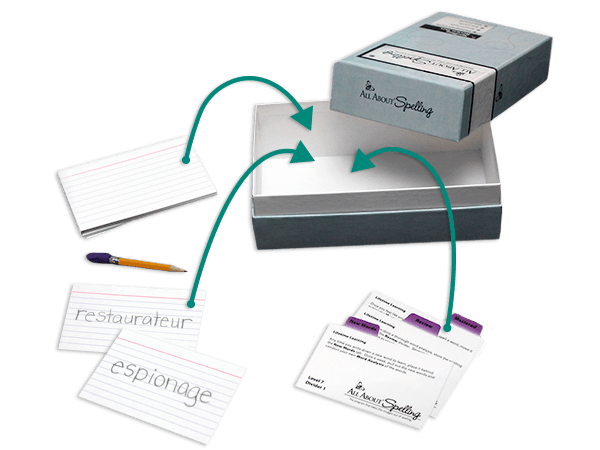
Now, any time there is a new word to learn, it goes behind the New Words divider. Once a week or so, your student can pull out the new words and conduct his own Word Analysis of them.
After the word analysis, the spelling words can be stored behind the Review divider. Then, several times a week, your child should set aside some time to practice spelling these words.
When he is sure that he won’t forget how to spell the words, your child can move reviewed words behind the Mastered divider. And he can watch that stack get thicker and thicker over the years!
Remember: This Is a Self-Guided Process
After you’ve explained the system, turn the responsibility over to your child. Ideally, he should choose the words that are important to him and schedule his own review time.
Our young friend Josiah just completed AAS Level 7 and is ready for lifelong spelling success! Josiah’s mom Carol recently sent us this wonderful note along with the photo of Josiah at the top of the page:
“Just wanted to share that my son (age 10) finished AAS Level 7 today! This has been a wonderful journey with your spelling program. My son has learned so much, and to be honest, so have I! It’s very important to my son to know the “why” behind things like math, spelling, the English language, science, etc. Your system introduced spelling in a way that kept it interesting and made sense. I recommend AAS to all my homeschool friends because I think it has got to be the best spelling program out there! Thank you so much for all you’ve done to create such a great learning tool!”
Is your student an AAS graduate? Or are you still looking forward to the day?


Comments
No comments yet. Our team reads and replies to every one.