


Welcome to our mini teaching guide on alphabetizing!
Why Teach Alphabetizing?
Even with modern technology, alphabetizing is used in many areas of our lives. In fact, you’ve probably used your alphabetizing skills this past week without even realizing it. Maybe you looked up a friend’s phone number in your contact list, or maybe you’ve looked something up in a book index.

Here are some other common uses of alphabetized lists:
- Finding a song on a playlist arranged by artist’s last name
- Locating a recipe in a recipe box
- Filing a document in a cabinet
- Using a map for public transportation
- Locating a store by using the mall directory
- Looking up information in a textbook glossary
- Finding a book on a library shelf
- And MANY more!
As you can see, alphabetizing is an essential literacy skill, and the resources in this post will make it easy for you to help your child master this important skill.
Let’s dig in!
Four Stages of Alphabetizing
Children go through four stages when learning to alphabetize.
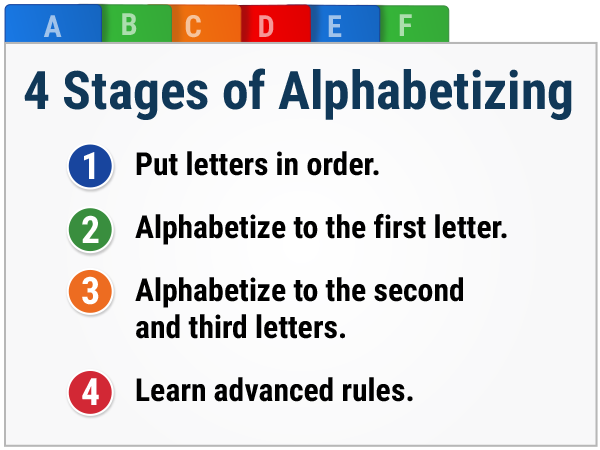
Here are hands-on activities and tips for each stage.
Stage 1: Put Letters in Order

At this beginning stage, kids learn to arrange letters in A to Z order. You can use letter tiles, Scrabble tiles, or squares of paper, or you can download our free ABC Caterpillar activity.
Play with Our Colorful Caterpillar
This adorable hands-on activity promotes letter recognition and builds pre-reading skills. And as an added bonus, you can use the letter cutouts from this activity for some of the additional activities described in the tips below!
Follow these tips to help reinforce Stage 1 alphabetizing skills:
- Work with your child to put the letter tiles in order at the beginning of each spelling or reading lesson.
- Sing the alphabet song together.
- Demonstrate how to start from different points in the alphabet. For example, lay out letter tiles A through M, and then have your child start the alphabet song from L and finish alphabetizing tiles N through Z.
- Hand your child the letter tiles in random order. Teach him that M and N are in the middle of the alphabet, so that when he gets those tiles he knows he should set them in the middle. As you hand your child each tile, he should decide if it is in the first half or the second half of the alphabet.
- Ask questions such as “What letter comes after P?” and “Is H in the first half of the alphabet or the second half of the alphabet?”
Stage 2: Alphabetize to the First Letter

Play “Sort the Seeds”
Once a child has mastered putting the letters in alphabetical order, teach him that words can be alphabetized, too.
Sorting the seed packets in this hands-on activity from All About Reading Level 3 is a fun (and colorful!) way to practice alphabetizing words according to the first letter.
Stage 3: Alphabetize to the Second and Third Letters

Play “Who’s Coming to My Party?”
In real-world applications, your child will come across multiple items that start with the same letter (for example, the names of children’s authors Sendak, Seuss, and Silverstein). The next step is to look at the second or third letter to alphabetize them correctly.
Alphabetizing to the second and third letters can be tricky—but not when you can play “Who’s Coming to My Party?” from AAR Level 4. This engaging activity will make learning this skill seem more like a party than a lesson!
Stage 4: Teach Common Rules for Advanced Alphabetizing

Download the Common Rules for Advanced Alphabetizing
When your child is more advanced and is consistently able to alphabetize words to the second and third letter, you’ve reached the fourth stage of alphabetizing. Now your child will learn what to do with last names such as McAfee, Macauley, and O’Kearney; book titles that start with The; and numbers.
Although alphabetizing is more difficult at this level, this handy quick guide takes all the guesswork out of applying more advanced alphabetizing skills.
Remember, alphabetizing is an important skill, but it doesn’t have to be a boring one. With these tips, your child will be alphabetizing like a pro in no time!


Comments
No comments yet. Our team reads and replies to every one.