


Go Bananas with Bananagrams!
How quickly can you take a handful of letters and create an intersecting grid of words? It’s a fun challenge!
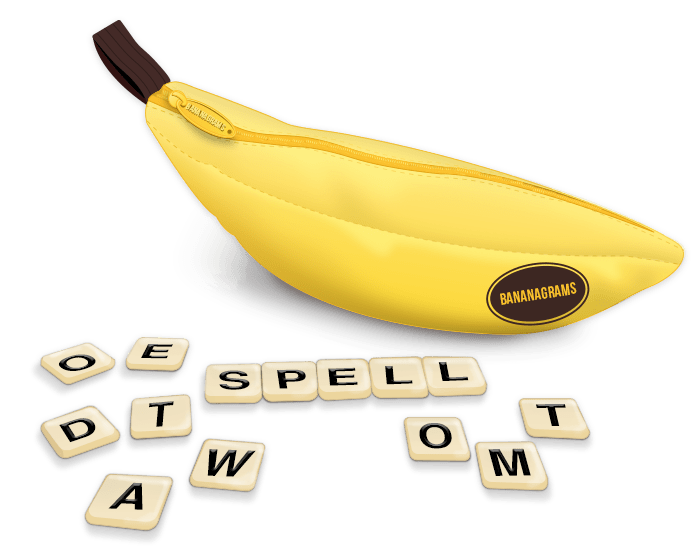
Bananagrams is a lively spelling game for ages 7 to 107 that will have your family and friends racing to spell as quickly as they can! You can build words horizontally and vertically, and you can shuffle them up anytime you need to—just make sure each word connects to at least one other word. You’ll have to be quick-thinking and fast-fingered if you want to be the first player to yell, “Bananas!”
The game comes with 144 letter tiles and is recommended for up to eight players to ensure that everyone gets sufficient tiles. But if you have more than eight eager players, Double Bananagrams has 288 tiles that allows for even more Bananagrams fun.
How to Play
Let’s get started!
The number of tiles each player begins with depends on the number of players. If you only have four players, then everyone takes 21 tiles from the “Bunch.” When everyone has their tiles ready and waiting face down in front of them, someone begins the game by calling out, “Split!” This is the signal to turn your tiles face up and get going!
Let’s take a look at your tiles.

It may not look like there’s any words in there at first, but don’t worry. Just grab the first one you see and lay it out. You could spell the word build.

But wait…you can add a suffix and spell building.

Did you notice you have a J in your bunch? Js can be hard to use, but there’s a way you can use it right away and spell jog. Hmmm…not so fast! You have an S too. You can add it to jog and turn it into jogs. Now you’re getting the hang of it!

Keep adding words until you have used all your tiles.

Look at that! You’re the first to finish. Quick, call out, “Peel!” That means you’ve finished and it’s time for all the players (including you) to grab another tile from the Bunch.
You drew an M!
Sometimes you have to rearrange your tiles as you draw new letters…but not this time. You can add your M to the end of see and make the word seem.

Time for another “Peel!”
Uh-oh—this time you drew a Q. What can you do with a Q?
Well, since Q is always followed by the letter U, you’ll have to use the U in building. Just take the EAK off of beak and make the word quake.

Way to go!
The game is over when there are no more fresh tiles in the Bunch. When that happens, the first player to use up all his or her tiles yells, “Banana!” and you have a winner!
Here’s our biggest tip: be prepared to rearrange your tiles into completely different words when you draw new letters. By the end of the game, your board might look like this:

See how many different words you can make with the same letters?

4 Ways to Build Language Skills with Bananagrams
- Broaden vocabulary. A strong command of the English language is a fantastic asset if you want to become a real Bananagrams champion. The more words you know, the easier it will be to win! The game introduces kids to new words and encourages them to expand their vocabularies as they search for words in their tiles.
- Reinforce spelling skills. If you have a child who would benefit from a fun way to practice spelling, this game is a terrific option! Not only is it super-engaging, it makes spelling practice practically painless. Kids will definitely love being able to shout “Rotten Banana!” when they spot a misspelled word in another player’s grid.
- Learn about anagrams. This game is called Bananagrams for a reason! An anagram is a word formed with letters found in another word. Because players may have to rearrange their letters multiple times throughout a game, it gives kids the perfect chance to explore the vast number of words that can be made with the letters they’re given.
- Gain familiarity with word parts. Bananagrams requires careful strategy; while it sometimes pays to just slap down whatever words you see, you can increase your chances of winning by paying attention to blends, consonant teams, vowel teams, prefixes, and suffixes. Kids will learn to keep an eye out for handy combinations like EN, ED, ES, TION, and ING, and they’ll get comfortable using them to create words.
Notes from Our Game Testers
- This game is an absolute blast!
- There are many options for adjusting the game to make it different and keep it exciting. The instructions included with the game offer suggestions for more ways to play, but don’t be afraid to invent your own. You might especially need to make adjustments when playing with younger children.
- Unlike some games that take a while to set up (here’s looking at you, Monopoly), Bananagrams requires no scoring, pencils, paper, or other tools to play. All you need are the tiles and a few eager players!
Does your family have a favorite board game that is a fun and “sneaky” way to build language skills? Please share in the comments below!


Comments
No comments yet. Our team reads and replies to every one.