


Does your child guess at unknown words instead of sounding them out?
The “word guessing” habit can stand in the way of learning to read. In this post, you’ll learn why kids guess and how you can solve the problem.
Why Do Kids Guess?
Kids don’t guess to annoy us or because they’re lazy; they may simply be using the process that seems most logical or intuitive to them.
Some kids guess because they have been taught to guess. Believe it or not, guessing is taught as a reading strategy in many schools, so previous teachers may have encouraged a student to look at the pictures or use context clues to see if he could figure out what the unknown word was.
Guessing is common among children who have been taught with the whole word or sight word method. They are accustomed to looking at the beginning letters and shapes of the words instead of paying attention to each phonogram in the word.
Some kids guess because they don’t know what else to do. They haven’t been taught phonics or strategies for breaking down multisyllabic words.
The 4 Types of Word Guessers
What type of guesser is your child?
- “First Letter” Guesser: This child looks at the first letter and guesses what the word is. For example, if the word is heart, the child looks at the H and says horse.
- “Word Shape” Guesser: This child looks at the first and last letters of the word and at the basic shape in the middle of the word, and takes a wild guess. For example, if the word is maple, the child says maybe. Both words begin with M and end with E, and the words have a similar shape in the middle.
- “Picture Clue” Guesser: This child looks at the pictures to help him guess the word. For example, the child may come across a sentence like The scary dog barked at the cat. The child doesn’t know the word scary, so he looks at the picture of the angry-looking dog and guesses the word angry.
- “Context Clue” Guesser: This child uses context clues to guess the missing word. For example, the child may come across a sentence like The farmer bought grain for his cattle. The child doesn’t know the word cattle, but the first letter is C, and based on the context she guesses the word chickens.
What’s the Solution for Word Guessing?
The All About Reading blending procedure is a great solution for helping word guessers.
Here at All About Learning Press, we’re big believers in finding simple solutions for solving reading problems, including word guessing. The blending procedure explained below is a highly effective method for solving this issue. This free download provides an illustrated summary of the blending technique.
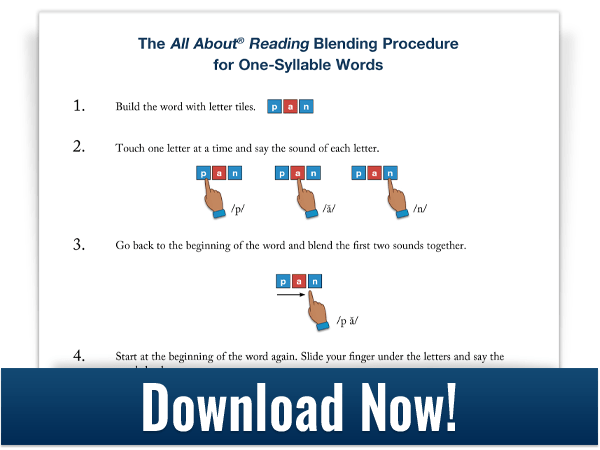
Here are the basic steps:
- Using the Letter Tiles app or physical letter tiles, build the word your student is having trouble with.
- Have the student touch each phonogram and say the sound.
- Have the student blend the word together as shown on the PDF.
With this method, your child will develop the good habit of looking at each phonogram, starting at the beginning of the word, and then progressing through each phonogram in sequence. It won’t take long before your student will transfer this blending skill to printed words and you won’t need the letter tiles.
Practice this blending procedure for a few minutes a day, five days a week, and soon you’ll be able to say adios to the word guessing habit!
Do you have a child who is a word guesser, or did you manage to escape this bad habit?


Comments
No comments yet. Our team reads and replies to every one.