



Compound words are formed when two smaller words combine to form a new word, as in these examples:
mail + box = mailbox
milk + shake = milkshake
note + book = notebook
The resources in this article can help you introduce compound words to your children and make them feel like superheroes for being able to read and spell such long words!
What Is a Compound Word?
Compound words can be lots of fun for young readers and spellers. And they are easier to tackle if we think of compound words as two smaller words that are combined to form a new word.
But there’s another important thing to consider when teaching compound words!
When deciding of a word is a compound, remember that the meaning of the compound word relates to the meanings of the two words that combine to form it. For example, a bathtub is a tub you take a bath in. A sandbox is a box you put sand in. An anthill is a hill made by ants, and so on.
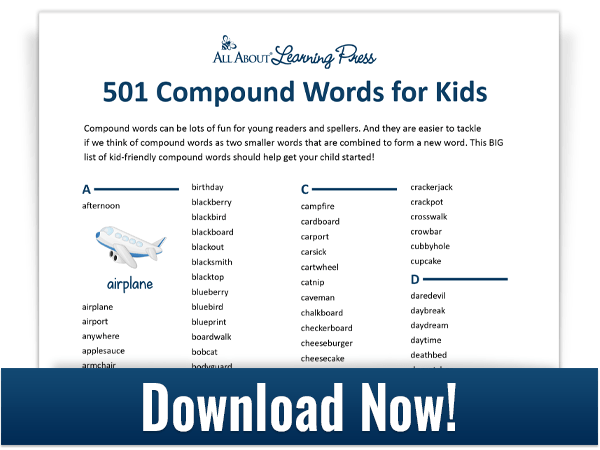
Download This Free List of Compound Words
This big list of kid-friendly compound words will be a great resource as you work on this skill together.
Teach How to Look for the Two Smaller Words in the Compound Word
The easiest way to introduce compound words is with letter tiles. Choose a word such as bathtub from the resource list and build it with the tiles.

Explain to your child that the word bathtub has two smaller words in it, and invite him to find those two smaller words. Letter tiles are great for this activity because your child can separate the compound word into two words, like this:

Suddenly, longer words are no longer scary! See why I love letter tiles so much? You can practice this concept with fun words like sandbox, anthill, backpack, and windmill. This is a wonderful method for helping students visualize the words that form compound words.
Games and Activity Sheets for Compound Words
Hands-on games and activities make learning about compound words more fun! Here are three free printables that you can use with your child. The first two activities come from All About Reading Level 1, and the third activity was designed for all reading levels.
“Bird Friends” Activity
Birds of a feather flock together … and in this fun reading activity, birds of a feather make compound words, too! Just have your child select two matching birds and place them side by side on the branch. Each pair of birds makes a compound word!
“Chop-Chop” Activity
Practice compound words with this fun (and safe!) chopping game! Just cut out the knife and the foods, then let your child “chop” each compound word between its two smaller words. Read each smaller word, and then read the compound word.
“Banana Splits” Game
Use compound words to build the yummiest banana split ever in this delicious multi-level reading game. Every player gets an ice cream bowl and a stack of candy covered scoops of ice cream to play with. And the best part? Students of different levels can play together!
Spelling Tips for Compound Words
When your child is spelling, it may not be obvious when to combine two words into one. This process is made more difficult by the fact that there are actually three kinds of compound words. There are closed compounds, which we have been discussing in this article so far. And then there are open compounds and hyphenated compounds.
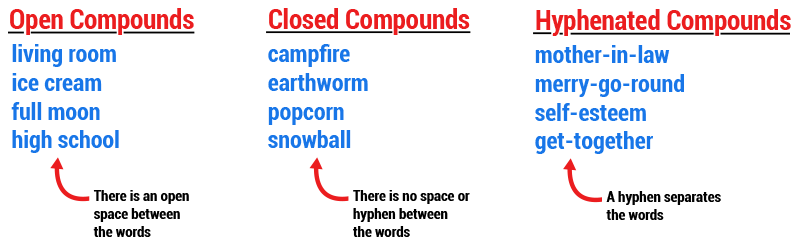
If your child needs to spell the word ice cream, for example, there is no rule that will help her decide whether this is a closed or open compound word. She’ll just need to determine what “looks right,” and the only way to do that is to have seen it in writing before (preferably multiple times). The Practice Sheets in All About Reading and the Word Banks in All About Spelling are excellent tools to do just that.
Of course, reading word lists isn’t all that exciting. Reading a short story about a sassy cat, on the other hand, is a much more engaging way to practice reading compound words! Here’s the first story with compound words that beginning readers encounter in All About Reading Level 1.
Cobweb the Cat short story
In this story, young readers encounter fourteen different closed compound words, including bathtub, catfish, and sunset. All of these words are pre-taught through various activities, so even before reading the story, the child has already become familiar with them.
The more times your student sees compound words in print, the easier it will be for him to spell them. And that leads us to our final tip for teaching children to spell compound words…
Provide Oral “Hints” During Spelling Dictation
To increase your child’s awareness of compound words during spelling dictation, provide prompts such as “This next sentence has a compound word.” After your child sees closed compound words in print a number of times, he’ll begin to get a sense of when to combine two smaller words into one.
The bottom line when teaching compound words is practice, practice, practice! But make practice a joy by incorporating letter tiles, activity sheets, short reading selections, and spelling dictation “hints.”
What are your favorite ways to practice compound words? Let me know in the comments below!


Comments
No comments yet. Our team reads and replies to every one.