


If your child has trouble counting syllables, or if you are teaching this concept for the first time, this post is for you! Read on to discover four fun ways to count syllables—and while you’re at it, be sure to check out all the extra practice activities and download a free printable “Count the Syllables” game.
But first, a quick definition …
What Are Syllables?
A syllable is a “word chunk” that contains a single vowel sound. A word may have one, two, or even more syllables. For example:
- bat has one vowel sound and therefore one syllable
- sticky has two vowel sounds and therefore two syllables
- south has one vowel sound—/ow/—and therefore one syllable

Four Easy Ways to Count Syllables
Most of us learned to count syllables with the first method below, the Clap Method. But for a little extra variety and a lot of extra fun, I’ve included three other effective methods. If your child just doesn’t “get it” with one of the methods, take a short break and then try a different one!
-
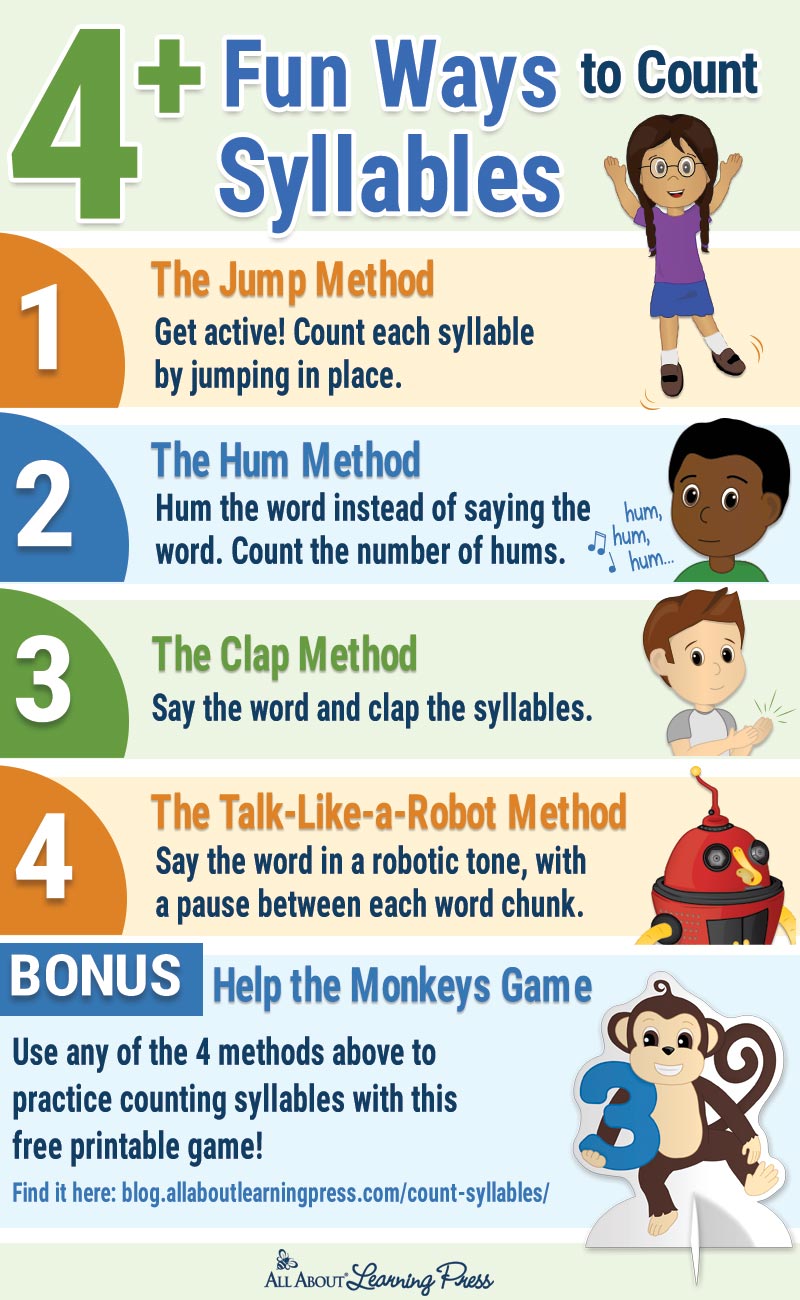
The Clap Method. The Clap Method is the most common way to teach syllable counting, and it works well for most students. Say the word and clap the syllables, like this:
-
The Hum Method. With the Hum Method, you hum the word instead of saying the word. Count the number of hums.
-
The Talk-Like-a-Robot Method. When you use the Talk-Like-a-Robot Method, you pretend you’re a robot and say the word in a robotic tone, with a pause between each word chunk.
-
The Jump Method. Get active! For each syllable, jump in place. Croc-o-dile would be three hops. Hap-py would be two hops.
Count Syllables with this Adorable Game!
Your child can use any of the four methods above (Clap, Hum, Talk-Like-a-Robot, or Jump) to practice counting syllables with this free printable game.

Count Syllables with SIX Fun Activities
Counting syllables is an important phonemic awareness activity, and that’s why we teach it several different ways in the All About Reading and All About Spelling programs. Children who have acquired this skill generally learn to read and spell much more easily. But don’t despair if your child doesn’t pick up this skill right away! It’s a rather abstract concept that can take time and repetition to sink in.
Here are some additional activities that can help your child identify syllables.
- Sing simple songs with a STRONG BEAT that your child knows.

For example, “Mary Had a Little Lamb.” Clap out each beat in the song like this: “Mar – y – had – a – lit – tle – lamb – its – fleece – was – white – as – snow.” Or you could try beating out the rhythm on a homemade drum (box and spoon, or oatmeal container and chopsticks). Call it music class, and work on it a little each day. Be sure to pick songs in which each syllable is sung on only one beat.
- Play a robot game with your child.
Your child gives you a word, and you say it in your best robotic voice, separating the syllables. Then switch roles—you give your child a word to try. Have a contest to see who can sound the most like a robot!
 Clap the syllables in compound words.
Clap once for foot, once for ball, and then put it together and clap twice for football. Other compound words that work well include cobweb, backpack, rainbow, toothbrush, cupcake, popcorn, and airplane. You can get some extra mileage out of this activity by using it as you teach and practice compound words, too!
- Turn mealtime into practice time.
At mealtime, use the food on your plate as inspiration for a syllable counting game. One at a time, each family member announces what he is eating. As you say what you’re eating, playfully break up the words into chunks. “I’m eating a pic-kle!” “Would you like some spa-ghet-ti?” “Please pass the sal-ad.“
 Play “going to the zoo.”
Take turns calling out animal names and, if possible, the sounds they make. Then everyone can jump, beat, or clap to the syllables. Here are a few examples: “I went to the zoo, and I saw a kan-ga-roo.” “I went to the zoo, and I saw a ze-bra!” “I went to the zoo, and I saw a tur-key, and the tur-key said, gob-ble-gob-ble!”
- Clap the syllables in the names of friends and family members.
This is also a wonderful way for your child to work on remembering all his relatives’ names!
Keep It Fun!
Above all, keep your syllable counting practice light and playful, and if your child doesn’t understand right away, try again in a week or so with a different method or activity. Need a reminder? Download the handy chart below and hang it right on your fridge!
Does your child know how to count syllables? Which of these activities have you tried?


Comments
No comments yet. Our team reads and replies to every one.