


Some children seem to learn to read by osmosis; they just “get it” without having to learn the phonics code that makes sense of reading.
But learning to read isn’t always that simple.
Many children require a systematic approach to teaching reading that allows them to learn incrementally. And as children learn to read, decodable books become an important part of the learning process.
But now you’re probably asking a pretty important question.
What Are Decodable Books?
Decodable books are books that contain only phonetic code that the student has already learned.
For example, a child at the beginning stages of reading who has learned the short vowel sounds could decode simple words like hat, bed, and pig, but would not be able to decode words like see and owl. A student at a higher reading level who has learned multi-letter phonograms like AI and OA would be able to decode more complex words like snail and goat.
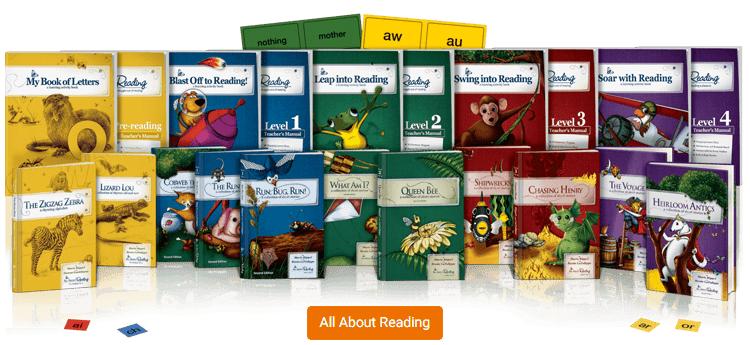
When searching for books for your beginning reader, be aware that the term decodable books is often used incorrectly, particularly when it refers to texts in which only about half the words are decodable. Being able to decode only half the words in a book is very frustrating for most students, and does not support good reading habits. Truly decodable books—like the ones in the All About Reading program—are 100% decodable so the student is able to read every word.

Why Are Decodable Books So Important for Beginning Readers?
When a child is expected to read books that are not decodable, he often becomes frustrated and starts guessing at words, thereby developing poor reading strategies. In the process, the child loses the direct connection between the phonics and word analysis skills he is learning and the actual text he is expected to read.
On the other hand, when a child reads a fully decodable book, he can use his knowledge of phonics and his word analysis skills to decode unfamiliar words. Because the child can figure out every word in the book, he feels successful, which in turn helps him build fluency and develop good reading strategies.
What’s Unique about the AAR Decodable Books?
Besides being 100% decodable, the stories in our reading program are designed to help students experience a real feeling of success and accomplishment. And that success sets in motion an upward spiral that results in even greater motivation to read.
Here are the features that make our decodable books so special:
-
The stories are engaging and entertaining.
It’s a challenge to write engaging stories with controlled word lists, but the results are worth the effort! Each book contains a wide variety of story lines, subjects, and themes that capture children’s interest and give them lots of practice in reading words they have learned. Each short story helps kids expand both their minds and their reading ability.
Here’s an example of a Level 1 story from All About Reading.

-
Our stories use natural language.
Most decodable books use stilted, unnatural language, mainly because authors find it difficult to create stories with controlled word lists. But those awkward sentences are hard for kids to read and comprehend, and may even turn some kids off of reading.
Kids shouldn’t have to suffer through the typical stilted language of most decodable text. If we wouldn’t want to read it, we shouldn’t expect kids to! That’s why we take such great care in crafting each story to ensure that it flows as easily and naturally as possible. Kids are delighted when they read these stories, and they want to come back for more.
Here’s an example of a Level 2 story from All About Reading.

-
The illustrations draw the child into the story.
The right illustrations can go a long way toward enhancing a child’s motivation to read, and illustrations are an important part of our decodable books. Our illustrators create real personalities for each character so children can relate to them. Then they often add extra surprises and details to each scene for children to discover—and those discoveries delight the child and give him a sense of “owning” the story.
Here’s an example of a Level 3 story from All About Reading.

Since the controlled word lists may limit what we can write, the illustrations may also be called upon to “fill in the blanks” of the story. However, it’s important to note that while the illustrations enhance the story, they never “give away” the words—that is, readers cannot guess the words by looking at the illustrations. It’s vital for the child to decode each word rather than rely on the illustrations for clues, so the drawings don’t enable the reader to “predict” the words on the page.
Here’s an example of a Level 4 story from All About Reading.

-
The text and pages are formatted very intentionally.
Our books contain four specific formatting features that make a difference in your child’s reading experience:
- In the early levels, the text has intentional line breaks to encourage natural phrasing.
The pages are formatted to allow beginning readers to read more smoothly and comprehend the text more easily. You have probably heard a child read a sentence choppily, like this:The. . .ten. . .kids. . .thank. . .the. . .king. . .for. . .the. . .gifts.
With the line breaks and natural phrasing we use in our books, the child is encouraged to read one phrase at a time, like this:
The ten kids
thank the king
for the gifts. - Subtle underlines in our Level 1 books help children with tracking issues follow the words across the page.
The underlining goes unnoticed by children who don’t need it, but it is invaluable for those who do need it. - The font used in Level 1 was customized to be simple and clear.
For example, the p’s are easily distinguished from the b’s and the q’s, which is important for beginning readers and dyslexic students. - Finally, our books are printed on non-glare paper specially chosen to be easy on children’s eyes.
Small details like these make a big difference in the experience of a beginning reader.
- In the early levels, the text has intentional line breaks to encourage natural phrasing.
View more story samples from our Level 1-4 Readers.
Of course, students don’t read decodable books forever. But decodable books offer benefits that help beginning readers develop the skills and confidence they need to become strong readers. Soon enough, they’ll be able to read everything on the shelf!
The All About Reading program walks you through all the steps to help your child become a strong independent reader. The program is multisensory, motivating, and complete. And if you ever need a helping hand, we’re here for you!
Have you used decodable stories with your students?


Comments
No comments yet. Our team reads and replies to every one.