


Here’s a fact: Your child is going to make an occasional spelling mistake.
The question is: How will you handle these mistakes?
Now is the perfect time to think through the answer to this question—because the way you handle errors can make a huge difference in your child’s ability and confidence. So let’s dig in!
Right off the bat, I’d like to share my “thought filter” for dealing with spelling mistakes.

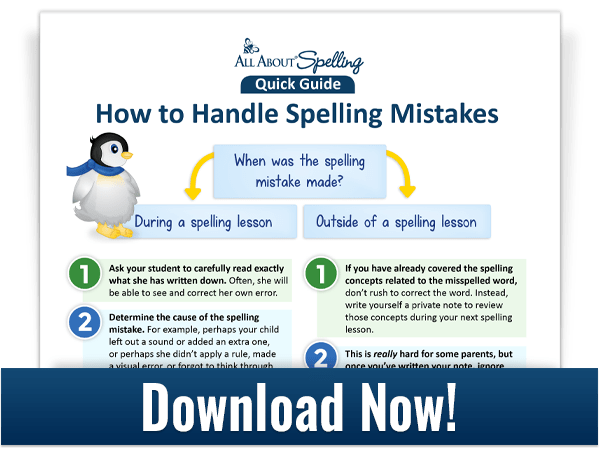
As you can see from the graphic above, there are really just two scenarios you need to be concerned with. First let’s zoom in on how to handle errors made during spelling lessons.
How to Handle Spelling Mistakes Made During a Lesson
When you’re in the middle of a spelling lesson, a mistake may seem like a reason for concern. But, in fact, every spelling mistake is a chance for your child to learn.
-
Ask your student to carefully read exactly what she has written down.
Often, she will be able to see and correct her own error. -
Determine the cause of the spelling mistake.
For example, perhaps your child left out a sound or added an extra one, or perhaps she didn’t apply a rule, made a visual error, or forgot to think through syllables or root words. Talk through the reasons the word is misspelled. Doing this will help the correct spelling make more sense to her than if you simply correct the mistake without explanation. If you need to review a phonogram or a rule, now is the time to do it.It’s important to keep those spelling rules fresh in your child’s mind!
- Demonstrate the rule by writing it out or using the letter tiles to spell the troublesome word correctly and explaining how the rule applies.
- Have your child spell other words that follow the same rule or generalization.
- Be sure to revisit that rule several times over the next few days until your student demonstrates mastery of it.
-
Have your student spell the word again.
First have her spell the word with the letter tiles and then once again on paper. -
Add the word to your child’s spelling review box.
Leave the word in the review box until your child can spell it quickly and easily. Regular review of challenging words allows ample opportunity for the correct spelling pattern to be ingrained in your student’s mind.
If your child misspells many words during spelling lessons, that’s a sign that you should slow down the pacing of your lessons. You want to make sure she masters the current spelling patterns before you add more.

Outside of spelling lessons, it’s a different scenario. Read on to find out how to handle those types of spelling errors.
How to Handle Spelling Mistakes Made Outside of a Lesson
When your child is writing during free-writing time or completing assignments for other classes …
- she isn’t working with a controlled word list but is probably using words that contain concepts she hasn’t learned yet.
- you aren’t watching her write out each word.
- you don’t want her to limit her word choices to avoid being corrected. Instead you want to encourage creativity and freedom.
So we need a different approach for misspellings that occur outside of spelling lessons. This two-step process will help.
-
If you have already covered the spelling concepts related to the misspelled word, don’t rush to correct the word.
Instead, write yourself a private note to review those concepts during your next spelling lesson. -
This is really hard for some parents, but once you’ve written your note, ignore the spelling mistake!
Don’t mark up your child’s paper with spelling corrections, and don’t require her to correct it.
Note that you will be holding your student responsible for writing words correctly if they include concepts you have already taught, but at this stage, when the mistake is made outside of the spelling lessons, you won’t be stopping everything and making her rewrite. Wait until the next spelling lesson to review the related concepts.
Download the “How to Correct Spelling Mistakes” Quick Guide
You may want to download our “cheat sheet” and tuck it into your teacher’s manual for a visual reminder of the two main ways to handle misspellings.
Still have questions about correcting your child’s spelling errors? Here are a few more tips!
Common Questions about Misspellings
“My child looks to me for feedback as he spells. What should I do?”
When you dictate spelling words and sentences, don’t watch your child spell the word! Wait until he says he is finished spelling before you look. Otherwise, some kids learn to watch your facial expression to see if they are on the right track.
“Will the improper spelling become imprinted?”
One school of thought suggests that children should never see an incorrectly spelled word for fear that the misspelling will get imprinted on your child’s mind. The idea is that if a child begins to choose the wrong letter, you should correct the error right away so that the child never sees or writes a word incorrectly.
But there’s a flaw in this reasoning: when your child makes a mistake, he already thinks he’s writing the correct answer, which means he already has the incorrect spelling in his mind. Simply correcting his mistake and moving on may not accomplish the learning you hope it will. Worse yet, when you rush to correct your child’s spelling, it undermines his judgment.
You want your child to learn to trust his own ability to identify and correct mistakes. But when you correct your child prematurely, he learns to doubt his own judgment instead. He also learns that he can rely on outside correction, eliminating the need to internalize rules, patterns, and other spelling strategies.
This is exactly the opposite of what you want your child to do.
“Why should students re-read what they’ve written?”
When you give your child the opportunity to recognize and correct his own errors, you’ll be able to more clearly determine what your child actually knows and understands. You may think he has mastered a rule or pattern, but when you observe that he isn’t able to correct an error involving that pattern, it reveals a gap in his understanding.
When given the chance, kids can often identify and correct their own mistakes. In fact, self-correction is much more effective than outside correction in helping kids master correct spelling for future encounters with a difficult word or pattern.
And think about it: it’s pretty annoying to be corrected for something you know but didn’t have a chance to fix on your own, isn’t it? It’s much more satisfying to be able to fix your own mistakes without being micromanaged.
“In spelling class, how long do you wait to correct a misspelling?”
When you are dictating spelling words, work with your child to correct any misspellings right after your child lets you know that he has finished spelling the word and is ready for you to look at it.
When you are dictating sentences, allow him to finish the entire sentence before correcting spelling errors. Ideally, check each sentence after it has been written. Don’t wait until the next class to check his work.
Wouldn’t it be nice if spelling wasn’t difficult? Download my free report, “6 Ways We Make Spelling Easy,” and discover how the All About Spelling program takes the struggle out of spelling.



Comments
No comments yet. Our team reads and replies to every one.