



Have you ever taught your child something one day, only to have him completely forget it the next? That is one of the most frustrating things as a teacher, isn’t it? One of your main goals is to make reading and spelling “stick” in your child’s brain, and this blog post will give you solid techniques for doing just that.
Short-Term vs. Long-Term Memory
This will be quick, but it is important to understand the basic differences between short-term and long-term memory.
Short-term memory is a system for temporarily storing, managing, and recalling the information necessary to carry out particular tasks. It keeps track of things like where you parked your car an hour ago or what you plan on having for dinner tonight. For your kids, facts stored in short-term memory might include the spelling for the word stationery or the new grammar rule they learned this morning.
Long-term memory, on the other hand, is a system for permanently storing, managing, and retrieving information for later use. Long-term memory helps us remember and recall things like proper spelling, punctuation rules, and vocabulary words. Items of information stored as long-term memory may be available for a lifetime. And that is what you want for your child—permanently ingrained learning.
Why Review Matters
If you want to make learning stick, you must include review in your lessons.
Parents and teachers often lament, “I taught this same information to Joey last month, and now he’s forgotten it.” They wonder what is wrong. They don’t realize that presenting the material once or twice isn’t enough. It’s not their fault—they just honestly don’t know how critically important it is to review. Review is an area that isn’t stressed nearly enough by educators or curriculum developers.
But the truth is, to make sure that your child really knows the material, you must have consistent and direct review. You can’t leave it up to chance and hope that your teaching will stick in his brain. As his teacher, you must take responsibility and ensure that your child remembers important information.
A Plan to Make Reading and Spelling Stick
Without a plan, you are probably settling for short-term learning without even realizing it. Short-term learning is damaging for several reasons. Not only is it a waste of time, but it also sets up a cycle of intense frustration for both you and your child.

When your child forgets a lesson soon after you present it, you feel like you are spinning your wheels and not getting anywhere. You might even begin to wonder if your child has a learning disability. But even worse than that, when he can’t remember his lessons, your child probably feels like something is wrong with him. Depending on his personality, he may internalize the frustration or he may act out. Either way, it becomes harder for both of you to sit through lessons that you know aren’t going to stick.
There is a way out of this no-win situation, though.
7 Review Strategies in AAR and AAS
Seven important review strategies are built right into the All About Reading and All About Spelling programs.
- First, we make sure your child understands the main point of the lesson.
Your child doesn’t need to guess—it’s crystal clear what the goal of the lesson is. For example, when your child is learning how to add suffixes to base words, he’ll learn what suffixes and base words are, and the difference between consonant suffixes and vowel suffixes. Using letter tiles and suffix tiles (and our clear, scripted lesson plans), you’ll demonstrate exactly how to add suffixes to words. We test and polish the wording of every lesson to make sure that the teaching is understandable. After all, the lesson must be understood before it can be reviewed.
- Next, review is built right into the lessons.
At the beginning of every lesson, we prompt you to do a quick review of previously taught material. The built-in review ensures that you remember to do it and won’t be tempted to skip over it.
- Multisensory methods are used during review time.
Since children learn best using sight, sound, and touch, it’s important to use a variety of methods to review material. You’ll review reading and spelling concepts in multiple ways: with word analysis activities, flashcards, recitation, games, and practical applications like problem-solving, dictation, writing, and conversation. And we use the SMI method (Simultaneous Multisensory Instruction) for even more powerful review sessions.
- Review is more frequent when a new concept is first taught.
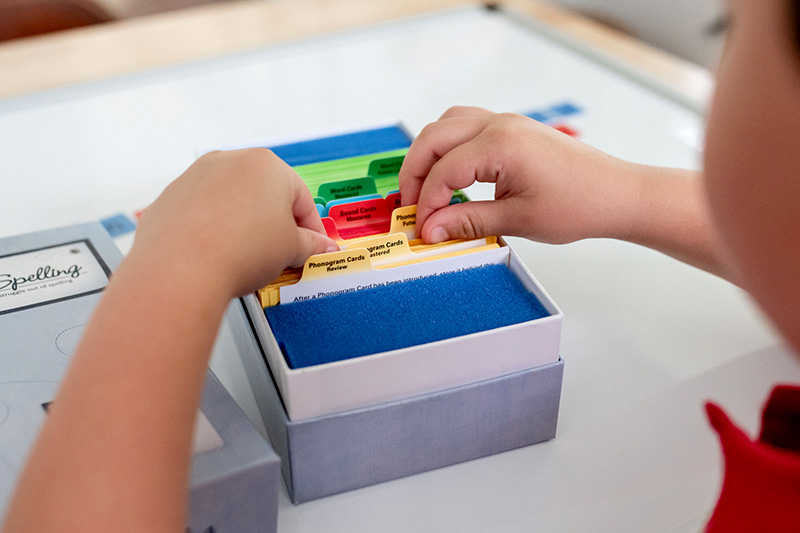
Timing is important. If you teach a new idea, but then don’t revisit it for a while, the chances that your child will forget it are much greater. That’s why we make sure that new material is reviewed daily at first. We keep it interesting with a variety of techniques like the Review Box, Fluency Practice sheets, Word Banks, and activity sheets. As your child shows mastery, we review less frequently, making room for other new concepts. Revisiting information this way pushes it into long-term memory and keeps it there.
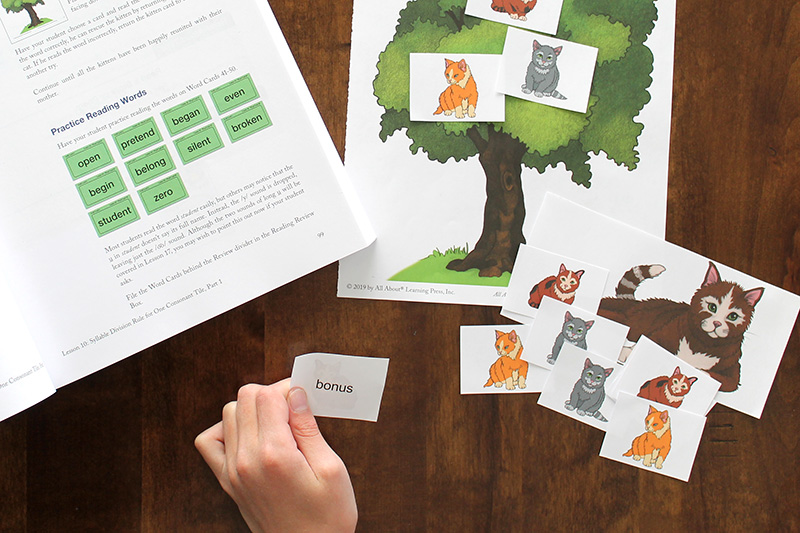
It’s also important to note that sometimes it appears that your student understands a concept when you first demonstrate it, but it may not be burned into long-term memory—so we don’t stop the review too soon. You want your child to be able to access the information years from now, not just a week from now, so concepts are reviewed at intervals and continued until the material has been completely mastered.
- Certain concepts are reviewed using the same words until they are completely mastered.
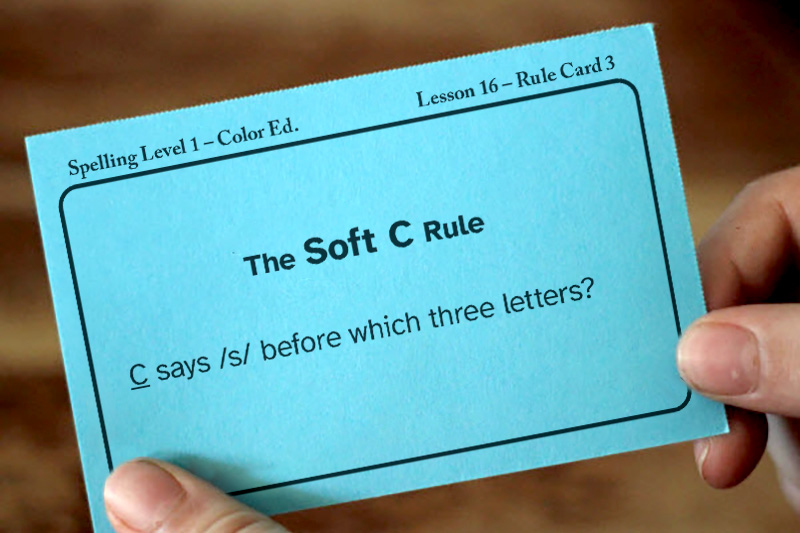
For example, when learning a spelling rule, we use the same wording each time we review it: C says /s/ before e, i, or y. Let that wording get ingrained in your child’s long-term memory so he can access it later when needed.
- Review is customized for each child.
Review is not a one-size-fits-all endeavor. Your child may need more or less review on a specific topic than the next child. If a concept has been mastered, you file it behind the “Mastered” divider in the Review Box and move on. If more practice is needed, you file it behind the “Review” divider. The system is as simple as can be, yet very powerful for making learning stick.
- Concepts are never “retired.”
We don’t just “teach it and forget it.” After we introduce a new concept, the lessons have your child apply his new knowledge to keep it fresh in his mind. Your student will use spelling words in dictation activities and encounter reading words in activities and short stories.

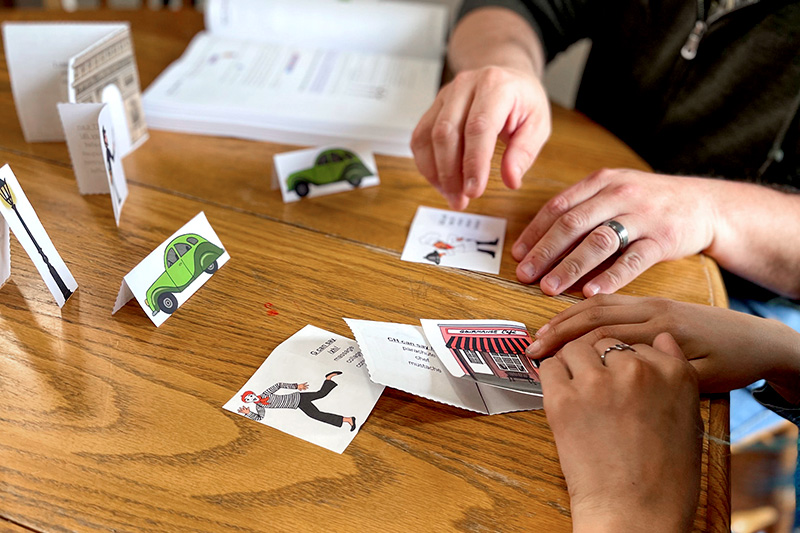
These review strategies are seamlessly woven into the entire reading and spelling programs. You don’t have to consciously remember to do them because they are built right into the curriculum. You can sit back, relax, and enjoy watching your child make consistent progress!
Additional Help for Your Child’s Memory
Download my free e-book, “Help Your Child’s Memory,” to learn more techniques to help strengthen your child’s memory and achieve learning that really sticks.

In this e-book, you will discover…
- Why information goes right over your child’s head … and what to do about it
- How the “Funnel Concept” can improve your teaching and result in long-term learning
- Schemas—what they are and how they help improve memory
- What “Simultaneous Multisensory Instruction” is, and why it is such a powerful teaching method
- Six things you can do today to improve your child’s working memory
Do you have a favorite review activity you enjoy using with your children? Share in the comments below!


Comments
No comments yet. Our team reads and replies to every one.