


Are you looking for the best way to teach prefixes? This mini teaching guide shows you how! And don’t miss the free printable prefix list, along with activities that help your child master words with prefixes.
What Is a Prefix?
A prefix is a word part that is placed in front of a base word. Common prefixes include pre, bi, and anti. Take a look at the examples below.
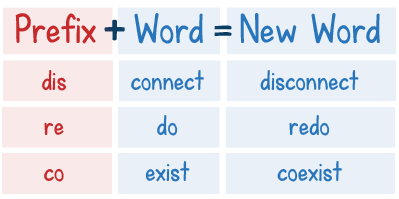
A prefix usually changes the meaning of the base word.
Think about the word happy. The prefix un placed in front of the word happy makes a new word with a new meaning: unhappy. The prefix un means not so it changes the meaning of the word happy to not happy.

The Two Most Common Prefixes
The most common prefixes are un and re. These two prefixes are the most useful for beginning spellers to learn because they appear frequently and their meanings are easy to understand and remember.

Un means not (unhappy = not happy) or the reverse of, or opposite of (as in untie).

Re means again (redo = do again) or back (as in repay).
If you’re interested in learning more about prefixes, download and print this list of 90 common prefixes.

Tips for Adding Prefixes
Tip 1: The spelling of the base word never changes. Simply add the prefix to the beginning of the base word, as in the word tricycle.

Tip 2: Be aware that double letters can occur. If you add the prefix un to natural, both the prefix and the base word retain their original spelling. The result is unnatural.

Other examples where double letters occur include misspell, irregular, and unnoticeable.
Tip 3: Watch out for prefix look-alikes. Some words contain the same string of letters as a prefix, but upon closer examination you’ll find that they are not prefixes. The re in real is not a prefix.

Other examples include uncle, pretty, and interest.
Tip 4: Sometimes a hyphen is needed. If you are working with an older student, it is handy to know the six rules for adding prefixes found in the next section.
6 Rules for Using Hyphens with Prefixes
A prefix is usually added directly to the base word, but there are several cases where a hyphen is needed.
Rule 1: Hyphenate the word when you add a prefix to a proper noun or a numeral.

Rule 2: Hyphenate the word when you add the prefix ex meaning former.

(Do not use a hyphen if ex means out of or away from, as in expel.)
Rule 3: Hyphenate after the prefix self.

Rule 4: Hyphenate to separate two A’s, two I’s, or other letter combinations that might cause misreading or mispronunciation.

Rule 5: A hyphen may be used to separate two E’s or two O’s to improve readability or prevent mispronunciation.

Note that many words with double E’s used to be hyphenated as a general rule, as in re-elect, re-establish, and pre-existing. However, current style manuals and dictionaries now tend toward “closing” the word except in cases where readability is affected. Both versions are currently accepted and listed in most dictionaries.
Rule 6: A hyphen is sometimes used after the prefix re to prevent misreading or confusion with another word.

As in “Re-cover the boat when you recover from the flu.”

As in “Please relay the message that they will re-lay the tiles.”
Printable Activities for Learning Prefixes
By now you’ve probably realized that we take prefixes very seriously here at All About Reading and All About Spelling! And though this guide to prefixes may seem like a lot of information, we don’t overload your child with all of this material at once. We teach just one small concept at a time, incrementally.
Here are a few prefix activities from All About Reading and All About Spelling.

Prefix Word Flippers
Practice reading words with prefixes with these Word Flippers. Download this activity from All About Reading Level 3.

Word Trees
Use Word Trees to explore prefixes in a novel way. Read more about using Word Trees in this this blog post, and download this activity from All About Spelling Level 7 to help your child practice building words with Word Trees.

My List of Prefixes
Download our blank list and let your kids create their own list of prefixes. Start with a few examples and have them add to the list as they discover more words with prefixes. Discuss the meanings of the words on the list as they are added.
We hope you feel better equipped with teaching prefixes. Was this post helpful to you? Be sure to check out our mini teaching guide on suffixes, too!


Comments
No comments yet. Our team reads and replies to every one.