


If your child struggles with reading fluency—and listening to him read aloud is a painful experience—then this article is for you!

We’ve all heard kids who read aloud with a choppy, almost robotic tone. It’s hard to grasp the meaning of what they’re reading. They may read too fast, or they may read too slowly and laboriously.
On the other hand, when someone reads aloud with fluency, it’s easy to understand what they are reading, and it’s a delight to listen to them. Fluent readers add emphasis to certain words and convey meaning with their expression.
What Is Reading Fluency?
Fluency is the ability to read with accuracy, proper speed, and meaningful expression.
Fluency is also a significant indicator of reading comprehension. When children can read fluently, it means that instead of using brain power for decoding, they can turn their attention to the meaning of the text.
And it gets even better. When students reach higher levels of fluency, they’re able to tap into metacognitive strategies. This means that they can visualize, question, and interpret what they are reading, and they can think about their own feelings and opinions while reading text. This is the highest level of reading comprehension.
Obviously, fluency is highly desirable. So let’s talk about how we can get your child to this point.
Good Decoding Skills Come First
Don’t even start working on fluency until your child can decode all the words in the text.
Does your child stumble over words? Substitute words? Need to sound out multiple words on the page? These are all signs that you need to work on decoding first; otherwise, you will both be frustrated.

In All About Reading, we give a lot of attention to decoding before we expect fluency.
- Kids read words in isolation (on flashcards that we call Word Cards).
- They read words in phrases.
- Then they read words in sentences.
- They encounter the words on fun and motivating activity sheets.
- And finally, they encounter the words in short stories.
By this point, students have significantly expanded their sight word vocabulary, and they have reached the point of automaticity for most of the words in the story.
THEN—and only then—we work on fluency skills.
The Importance of Vocabulary for Fluency
Does your child understand the meaning of all the words he’s reading?
If not, fluency will be an uphill battle for both of you. Even if he can decode the words properly, when he runs into a word he doesn’t understand, he will be unable to read smoothly and with expression.

Have you ever tried to read a book on a topic you were unfamiliar with? As you encountered words you didn’t know or understand, your fluency probably faltered. And quite likely, by the time you reached the end of a sentence, you had probably forgotten what the first part of the sentence even said.
That’s why we make sure students understand all the words in the short stories in our reading program without dumbing down the stories with simplistic words. On the contrary, we purposely introduce words that are very likely new to the reader. We use interesting, mind-expanding geographic locations, as well as a large variety of historical settings and nationalities.
But we don’t leave readers stranded with no hope of understanding what they are reading.
Instead, we have short attention-grabbing discussions before each story is read. We highlight new vocabulary words through illustrations, and take what the student already knows and use that as a “hook” for the new vocabulary words.
With this method, the student is mentally prepared when he encounters the word again in the short stories. He can read the word smoothly because he knows how it should be pronounced, and he can continue visualizing the storyline in his mind because he isn’t wrestling with the meaning.
When it comes to fluent reading, it’s easy to see why it’s a big help to have a good vocabulary that is relative to what your child is reading about.
Provide a Good Role Model
Another important factor in the development of fluency is the need for fluency role models. When your child hears fluent reading, it will be easier for him to mimic it and then eventually make it his own.
When you read aloud to your child, you’re setting an example. Your child is mentally absorbing your tone, your speed, and your inflections. That’s one of the reasons we encourage you to read aloud to your child for at least 20 minutes every day. Your child will become familiar with how a reader’s voice helps written text make sense.
Audiobooks are another fantastic resource for providing role models, not to mention they help you give your voice a rest! Here are some current favorites, to get you started.
- The Ramona Quimby Collection by Beverly Cleary (narrated by Stockard Channing)
- Charlotte’s Web by E.B. White (narrated by George Plimpton)
- Redwall by Brian Jacques (narrated by full cast)
Another thing that happens when your child hears books read aloud is that he learns “phrasing.”
Why Phrasing Helps
Consider this sentence:

This sentence would be really boring to listen to if each word were spoken with even pacing.

Fluent readers naturally group phrases, like this:

They automatically divide text into meaningful chunks, which is called phrasing. Children who have good phrasing intuitively know when to pause.
But what if your child doesn’t know how to do this yet? How can you teach phrasing?
To help your child get the hang of it, you can use a pencil to “swoop” under each phrase.

Phrasing usually occurs with prepositional phrases, but honestly, your own intuition will serve you well as you mark the page. Think of how you would read the text; there are no absolutely correct answers here, especially as you get into more advanced text.
If you use All About Reading, you’ll see that our Level 1 readers and Practice Sheets from Levels 1-4 are designed with intentional line breaks to help your child learn and understand phrasing. Here’s an example:

The pages are formatted to allow beginning readers to read more smoothly and comprehend the text more easily. The line breaks promote natural phrasing.
Encourage Expressive Reading
After years of listening to read-alouds, your child is probably familiar with how to interpret dialogue—reading text the way someone would say it. But it can still take some practice for novice readers to get the hang of adding expression to their own voices.
One way to encourage good expression is to model it with buddy reading. There are several forms of buddy reading, but for encouraging expression, it is most helpful if you read a page and then have your student read the same page after you. Demonstrate how to pay attention to punctuation, and how to emphasize important words.

Another great way to practice expressive reading is with an activity like this one from All About Reading.
In “Round Up the Sheep,” your child will discover that the same words can take on a completely different meaning when you say them with different expression. As you can see, encouraging expression and increasing fluency doesn’t have to be boring!
Silent Reading Isn’t as Effective for Improving Reading Fluency
This idea is probably clear from the previous sections, but it’s important enough that I want to be sure to say it outright:
Have your child read aloud, not silently.
Silent reading certainly has its place, but oral reading practice is much more effective in developing fluency.
Having an audience can be motivating and can give your student an opportunity to practice meaningful expression. Encourage your child to read to someone else, such as a sibling, a visiting neighbor, Grandma, or a parent.
Kids Can Self-Assess, Too!
It can be really helpful for kids to hear themselves read. And recording themselves can be fun!
Need an easy way to record? Here’s a recording program you can download for free.
After recording, let your child assess his own reading. How did it sound? Did it sound natural? Choppy? Did he pay attention to punctuation? Encourage him to notice one thing he did well and one thing that needs improvement. Then he can re-record and try to improve. Even professional speakers do this!
The Bottom Line on Improving Reading Fluency

Reading fluency develops gradually, but as you can see, there is a lot you can do to promote it.
As long as your child has strong enough decoding skills, the next steps are to:
- Help build a strong vocabulary.
- Provide a good role model, whether that is you or fantastic audiobook narrators.
- Use phrasing and “swooping” to break sentences into meaningful chunks.
- Tap into buddy reading to encourage expressive reading.
- Have your child record himself reading, and then self-assess.
And finally, keep encouraging your child! With your help, he won’t read like a robot forever. Fluency will come!
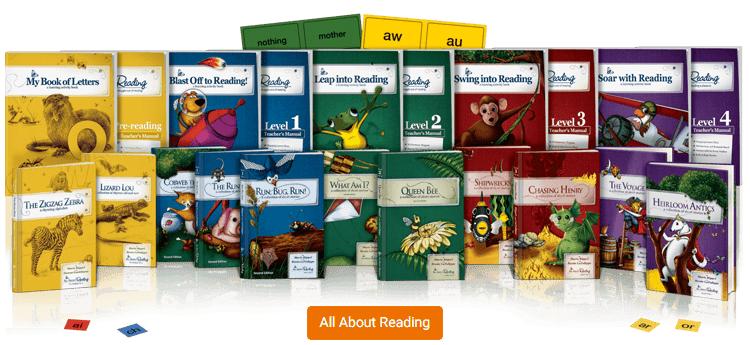
The All About Reading program walks you and your child through all the steps to help your child achieve fluency. The program is multisensory, motivating, and complete, with everything you need to raise a strong reader. And if you need a helping hand, we’re here for you.
What’s your take on teaching reading fluency? Have anything else to share? Let me know in the comments below!


Comments
No comments yet. Our team reads and replies to every one.