


Maybe you haven’t heard of schwas before, or maybe you’ve heard of them but are wondering how to teach schwas to your children. If so—read on! By the end of this post, I hope to have helped you make sense of the schwa.
What Is a Schwa?
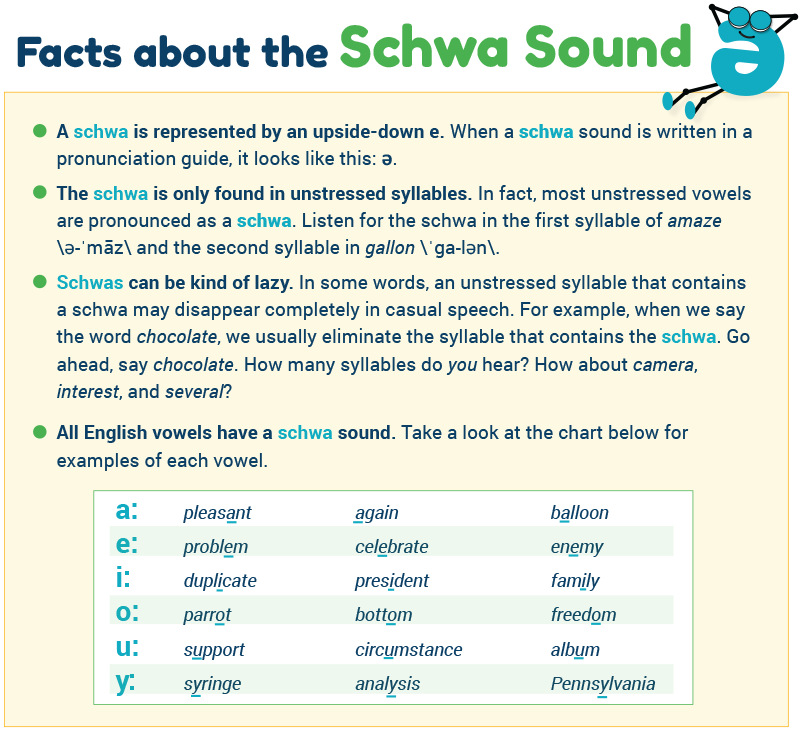
The schwa is a muffled vowel sound that is heard in countless English words. Say the following words aloud and listen for the sound of the underlined vowel.

See how the underlined vowel doesn’t say one of its normal sounds? Instead, depending upon the word, it says a muffled /ŭ/ or /ĭ/ sound. Also, do you notice how the schwa appears in an unaccented syllable? That schwa is what makes these words trickier to read and spell.
In All About Reading and All About Spelling, we don’t use the term “schwa” with the student. Instead, we teach several strategies to help children deal with words that have muffled vowel sounds in the unaccented syllable. Here are some of my favorite strategies for teaching schwas.
6 Strategies for Teaching Schwas
-
Teach your child to “pronounce for spelling.”
When learning to spell words that contain schwas, it really helps to “pronounce for spelling.” This is a simple technique in which we “over-pronounce” all the syllables, allowing us to clearly hear the vowel sounds. Take the word cabin, for example. Since the second syllable is unstressed, the letter I takes on the schwa sound, making it unclear which vowel to use for spelling. When we over-pronounce the word as “cab-IN,” it becomes clear that the letter I is used.
Here is how this works in practice:
1. “Spell the word support. I’ll pronounce it for spelling: SUP-port.”
2. The student repeats the word, pronouncing for spelling.
3. The student spells the word, and then reads the word normally: “support.” -
Use All About Spelling Word Banks to build visual memory.
Have your student read through the Word Banks to become familiar with seeing the correct spelling. Then, when your student hears a muffled vowel sound and isn’t sure how it should be spelled, she can try “scratch paper spelling” to help determine the correct spelling.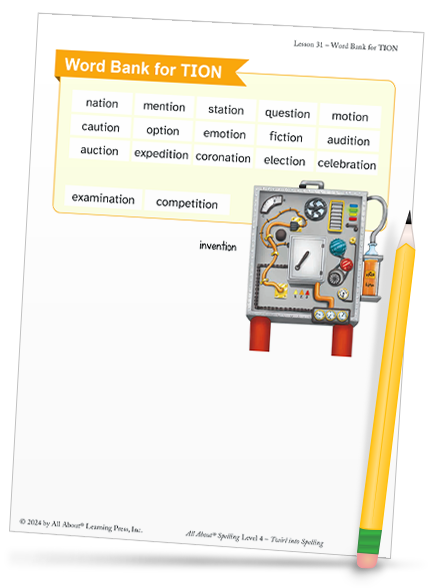
-
Encourage your child to think of related words.
If a child can’t remember how to spell the word definition (def-uh-ni-tion), he can think of the root word (define) and use it as a clue for choosing the vowel that is making the /uh/ sound in the word. -
When reading, be prepared to “say it like a word.”
If you read the word button with a short o sound in the second syllable, as in /bŭt-tŏn/, you’ll sound like a robot and listeners may have a hard time understanding you. Since there is a schwa in the second syllable, we have to be prepared to make slight adjustments in order to “say it like a word.”
Here’s how to lead your student through the “say it like a word” activity:
1. Choose a word that is in your child’s oral vocabulary, such as the word problem.
2. Say the word as if you were a robot, without using the schwa sound: /prŏb—lĕm/.
3. Have your child “say it like a word” by repeating the word in normal speech.Once your child is proficient at repeating the words using the schwa sound, you can remind him to use this activity as he reads to help decode unfamiliar words. Soon you’ll be able to remind your student to “say it like a word” and he’ll correct himself.
- Teach words of similar construction at the same time so your child can see the pattern.
For example, the letter A commonly takes on the schwa sound at the beginning of words like about, around, again, and so on. These words are taught together so that children will easily master this pattern. - Remember to review.
Students may need quite a bit of review with words containing the schwa, especially when it comes to spelling. Be sure not to skimp on review time, and have patience with the process. With practice and these strategies, your child can make sense of the schwa!

Has the schwa sound caused problems for your child? Which of these techniques do you think will be most helpful?


Comments
No comments yet. Our team reads and replies to every one.