


Short vowel sounds are the most common vowel sounds in the English language. Thankfully, these sounds are fairly easy to spell. Let’s dive in!
Because short vowel sounds are so prevalent in English, they are often the first vowel sounds that children learn. In All About Reading and All About Spelling, we always start with the short sounds when we teach the multiple sounds for vowels. For example, in All About Reading Level 1, Lesson 1, we teach that A says /ă/ as in apple.

It’s a great place to start. Once they learn the short sounds of the vowels and the consonant sounds, kids can decode hundreds of words! But just learning the simple spelling of the five short vowel sounds isn’t quite enough! You can help your child learn to read and spell even more words by teaching him four common ways to spell short vowel sounds.
Short Vowels Can Be Spelled in Four Ways
-
The most common way: a single vowel in a closed syllable usually says a short sound.
(In a closed syllable, a single vowel is followed by a consonant.)- In the word cat, A is followed by T and says /ă/.
- In the word pet, E is followed by T and says /ĕ/.
- In the word dish, I is followed by SH and says /ĭ/.
- In the word mob, O is followed by B and says /ŏ/.
- In the word tub, U is followed by B and says /ŭ/.
-
Vowel teams can make short vowel sounds.
(In a vowel team, two vowels work together to make one sound.)- EA can say /ĕ/ as in bread and sweat.
- OU can say /ŭ/ as in touch and young.
-
Single vowels can say the short sound of other vowels.
- A after W can say /ŏ/ as in water and want.
- Y in a closed syllable says /ĭ/ as in gym and myth.
- O can say /ŭ/ as in love and oven.
-
A vowel can make the short U or short I sound in an unaccented syllable.
(A schwa is a muffled vowel sound heard in an unaccented syllable in many English words.)- A can say /ŭ/ as in about.
- E can say /ĭ/ as in enemy.
- I can say /ŭ/ as in family.
- O can say /ŭ/ as in bottom.
- U can say /ĭ/ as in minute.
- Y can say /ŭ/ as in syringe.
Please note: the sound a schwa makes in a particular word may vary by region.
Let’s Dive a Little Deeper
The chart below illustrates the most common ways to spell the short vowel sounds.
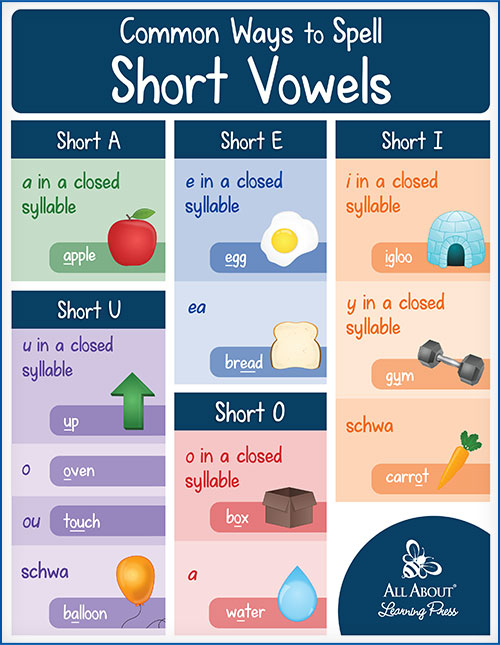
Click to Download our Printable Chart!
Although seeing the different spellings for short vowels on the chart above can be helpful for people who already know how to read and spell short vowel sounds, I recommend using the chart only for reference rather than as a learning tool. Teaching all these spellings at once would be overwhelming for a beginning student. Instead, teach them to students incrementally, one at a time.
Of course, as we all know, English has exceptions! In addition to the common spellings for the short vowel sounds, there are uncommon ways to spell them as well. Fortunately, these alternate spellings are few and far between.
- Short A: plaid, laugh, calf
- Short E: many, said, says, friend, leopard
- Short I: pretty, busy, build, foreign sieve, women, mountain
- Short O: all, thought, caught (all three words depend on regional dialect)
- Short U: flood
Sample Lessons for Short Vowel Sounds
Are you interested in seeing how we teach the short vowel sounds in All About Reading? Here is a sampling for you to download and enjoy!


The Bottom Line for Teaching Short Vowel Sounds
When it comes to teaching short vowel sounds, here’s what you need to keep in mind:
- There are four common ways to spell short vowel sounds.
- Teach these common spellings to students incrementally, one at a time.
- Keep it fun! Use a wide variety of interesting activities to help your student learn the four ways to form short vowel sounds.
All About Reading and All About Spelling walk you and your student through all the steps needed to help your student learn to read and spell. The programs are multisensory, motivating, and include everything you need. And if you ever need a hand, we’re here to help!
Looking for information on long vowels? Check out our Handy Guide to Long Vowel Sounds!


Comments
No comments yet. Our team reads and replies to every one.