


When you read, you probably don’t spend much time decoding the individual words. You just read, and as you get to each word, you instantly recognize it. But beginning readers don’t have that kind of instant recall yet, so it is important to teach them how to sound out words.
What Does “Sounding Out Words” Mean?
When you sound out a word, you say each sound in the word slowly (s…i…t), and then say the sounds together more quickly (sit). The technical term for this process is blending because sounds are blended together to form a word. Here’s a quick demo:
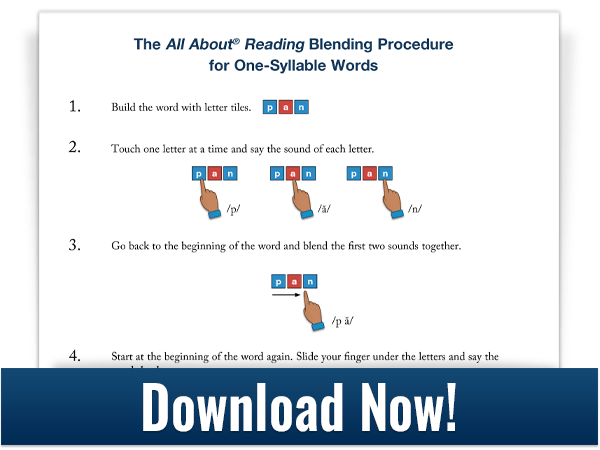
Our free Blending Procedure PDF has complete step-by-step instructions for both one-syllable and multisyllabic words.
Why Is Sounding Out (or Blending) Important?
When a child can say the sounds of the letters in the order in which they appear, and can then blend those sounds into a recognizable word, she is able to read thousands of phonetically regular words.
Because it unlocks so many words, blending is an important step toward the goal of reading comprehension. In fact, research shows that learning to sound out words has a powerful effect on reading comprehension.1

What Kids Should Know Before Sounding Out Words
Before you attempt to teach your child to sound out words, check to see if he is ready. Here’s a free Reading Readiness Checklist for you to download. If you discover that your child isn’t quite ready for reading instruction, you can use the All About Reading Pre-reading program to prepare.
After you’ve used the checklist to ensure that your child is ready to learn to read, it’s time to teach the letter-sound correspondences of several letters of the alphabet. The letters M, S, P, and A are a good place to start because the sounds are easy to pronounce and several interesting words can be formed right away.

Before we get into the four easy steps for teaching blending, let’s discuss a problem that many beginning readers encounter. Recognizing this problem will help you better understand the steps for blending.
Short-term Memory Issues Can Affect Blending
When kids first learn how to decode three-letter words, they have to juggle several cognitive processes simultaneously:
- They must recognize the letters.
- They must retrieve the sounds of those letters.
- They must hold all three sounds in the memory while they sound out the word.
There is a lot going on in their brains! In fact, it is very common for beginning readers to have difficulty with standard blending procedures. Just about anyone who has taught blending has encountered a situation like this:

What just happened there? Here’s the problem: by the time the child got to the third letter, he had forgotten the sounds of the first two letters, and then had to resort to guessing. But it’s not that kids can’t remember three things in a row—it’s just that there are too many competing processes going on in their heads at once.
It’s easy to understand the problem. But what can we do to help?
“Cumulative Blending” Solves This Problem
Cumulative blending is quite simple. Start by building a phonetically regular word with the Letter Tiles app or physical letter tiles and then follow the steps below. We’ll demonstrate with the word map.
- Touch one letter at a time and say the sound of each letter.
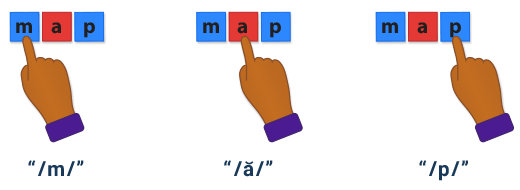
- Go back to the beginning of the word and blend the first two sounds together.
- Start over at the beginning of the word. Slide your finger under the letters and blend all three sounds together.
- Finally, say the word at a normal pace, as we do when we speak.
This is called cumulative blending because there are successive additions of the letter sounds. First we blend the first two sounds (/mă/). Then we start at the beginning of the word again, this time blending all three sounds (/măp/). If there were more sounds in the word, as in split, we’d start at the beginning of the word for each successive addition:
/sp/
/spl/
/splĭ/
/splĭt/
Cumulative blending provides the extra support, or “scaffolding,” that beginning readers need. When you feel your student is ready, he can try blending all three letters without this additional step, but don’t try to withdraw the support too soon. These steps and the support they provide help memory issues immensely.
Download a Free Blending Lesson

Would you like to see how we teach blending in the All About Reading program? Download this sample lesson!
This is the first lesson in AAR Level 1. The blending activities start on page 4 of the PDF.
The All About Reading program walks you through blending and all the skills your student needs to become a strong reader. The program is multisensory, motivating, and complete. And if you ever need a helping hand, we’re here for you.
What’s your take on teaching kids to sound out words? Have anything else to share? Let me know in the comments below!
___________________________________
1 University of Royal Holloway London. (2017, April 20). Phonics works: Sounding out words is best way to teach reading, study suggests. ScienceDaily. Retrieved May 1, 2017 from www.sciencedaily.com


Comments
No comments yet. Our team reads and replies to every one.