


“I’m worried my child isn’t making enough progress.”
Most homeschool parents feel this way at one time or another. We regularly hear from parents who express concern about the progress their child has made—or not made—in reading and spelling.
When we question the parent further, we often discover that the child has in fact made excellent progress, yet the parent doesn’t recognize that progress.
In these situations, however, the problem is actually much more likely to be related to the parent’s expectations for the child’s progress, rather than to the child’s actual progress. It is very easy to become too focused on “the ideal.”
What Is Your “Ideal?”
Your ideal may be different than someone else’s. Maybe your ideal is to have your child complete All About Reading Level 4 by a certain age or to have him spell as well as the child next door. Maybe your ideal has been influenced by what your child’s grandparents think about his progress. Or maybe it’s even thinking ahead to your child’s future college career with worried thoughts like, “How will he get into college if he can’t even spell proficiently?”
In all the cases above, focusing on the ideal can create frustration because, until your child actually reaches your ideal, you will always be focused on how far he still has to go until he reaches “it” … whatever “it” may be.

To varying degrees, envisoning your child’s future can serve you well because it helps you gauge what you need to do. After all, if you’re completely happy with the status quo, there would be no reason to teach your children every day.
But while focusing on ideals can help us set goals, it’s not a great way to measure progress in a motivating way. In fact, always comparing your child to the ideal can lead to disappointment … and the Big Pit of Comparison.
Stay Out of the Big Pit of Comparison
What is the Big Pit, you ask? This is the huge chasm between where your child’s abilities are now and where you want him to be.
The Big Pit is a bad thing. It’s bad for you and for your motivation. And it’s bad for your child, his sense of self-worth, his enthusiasm for learning, and his future progress.

So instead of this self-defeating way of looking at your child’s progress, let’s take a step back … no, let’s take a step up.
A Fresh Perspective
To better understand where your child is really at and to stay out of the Big Pit, it helps to get a bird’s-eye view of your child’s situation.

Look at the big picture from a vantage point where you can see the whole continuum, beginning with where your child started and ending with your ideal.
With this bird’s-eye view, you can see the ideal off in the distance, but you can also see how far your child has come.
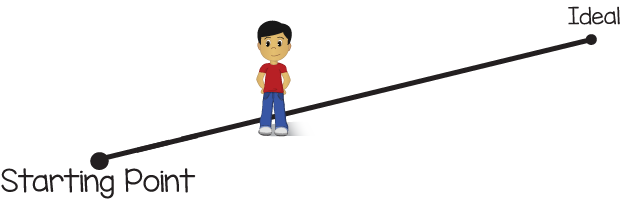
From this vantage point there is a LOT to celebrate.
What I would encourage you to do is frequently look backward instead of always looking forward. Instead of comparing your child to where you want him to be, think about where he started out. Then you can see how much progress has been made.
When you give yourself a bird’s-eye view, you can look back and see the ten-year-old who was struggling to read a year or two ago, but is now reading fluently. You can picture the boy who spent two or three days on each spelling lesson but can now complete a lesson in a day. You realize that the child who cried through every single fluency practice sheet is now smiling through them.
This new vantage point provides an inspiring perspective that will help you and your child stay motivated … and encouraged. It changes everything, doesn’t it? Can you see the difference?
Do you ever fall into the Big Pit of Comparison? What successes has your child had so far?


Comments
No comments yet. Our team reads and replies to every one.