


Does your child have gaps in reading and spelling?
Hundreds of thousands of children struggle to learn to read and spell. They spend hour after tiring hour being fed information, only to eventually be tagged as “unable to read” or labeled with a learning disability that keeps them from being able to spell.
It’s hard to believe, but according to statistics reported in 2019, more than 60% of fourth graders in the United States were reading below proficient levels.1 2
That’s a staggering number.
Let’s think about that for just a moment.
If you lined up ten random fourth-grade kids from across the United States…
… only four of them would be able to read at a proficient level. Just four. Six of the children would only be able to read at a basic level or below.
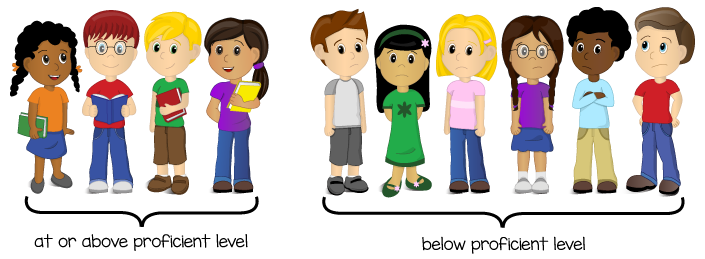
But if you live in certain states, it’s even worse: 72% of fourth graders in Michigan read below proficient levels. In New Mexico, it’s 77% of fourth graders. Among black students, it’s 81% of fourth graders. (Check out the reading stats for your state as reported by the U.S. Department of Education.)
However, these grim statistics don’t tell the whole story.
The Problem: Gaps
More often than not, the problem doesn’t actually lie with the child. Most reading and spelling problems are caused by gaps in the reading or spelling curriculum. Gaps are created when programs don’t follow incremental steps, or when information is taught in an illogical sequence. Such programs don’t build sequentially upon the information the child has already mastered. These gaps can cause lots of problems for kids. Here’s why…
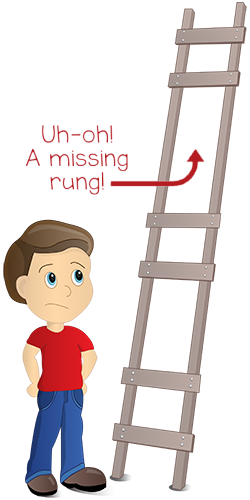
Imagine Climbing a Ladder with Missing Rungs
You’re in front of a tall ladder, and you’re expected to climb to the top. There’s a reward up there, and you’re excited to grab it. You don’t know it yet, but this particular ladder has a few problems. In fact, the ladder has some missing rungs. But it’s your job to climb it, so you begin.
Climbing the first and second rungs of the ladder doesn’t present a problem—the rungs are adequately placed, and you can put one foot ahead of the other. But when you lift your foot for the next step, you hesitate…because there is a gaping hole where the third rung should be. In order to take the next step, you have to really stretch. You have long legs and a strong upper body, so you can do it—but it isn’t easy. You make that big step and pull yourself up the ladder.
But wait! When you take the next step, you realize that there is another missing rung in the ladder. Good thing you are up to a physical challenge! Reaching and stretching, you eventually climb to the top of the ladder and claim your reward.
But What If You Can’t Overcome the Missing Rungs?
What if your legs aren’t long enough to stretch over the gaping holes? What if you don’t have the upper body strength to pull yourself up to the next rung? You will likely become discouraged and defeated, and may eventually give up. Should you be labeled as having a ladder-climbing disability for not being able to climb the ladder?
You may think it’s your fault that you can’t climb the ladder, but it’s not. The cards were stacked against you from the very beginning. The ladder wasn’t well constructed, so the designers of the ladder are to blame for the failure. The problem isn’t with you; the problem is with the ladder and its missing rungs.
A properly designed ladder makes climbing to the top possible—even for a person with challenges that would make climbing a faulty ladder impossible.
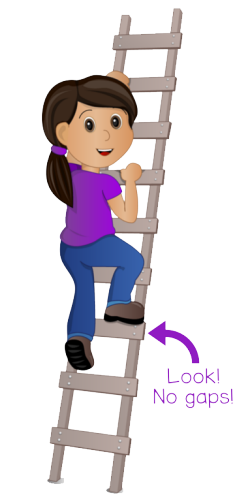
Learning to Read and Spell Is a Lot Like Climbing a Ladder
Each rung on the ladder represents an important concept that helps students get closer to the goal of fluent reading and spelling. If a rung (or concept) is missing, climbing (or learning) is harder than it needs to be. And as you can imagine…
…it’s much easier to climb a ladder that has all of its rungs.
For some children, a reading or spelling curriculum with missing steps is not a problem. Just as your long legs would help you climb a ladder with missing rungs, some children are able to intuitively fill in the gaps in a reading or spelling program.
But for many children, those missing steps present an insurmountable obstacle. Just like some people don’t have the physical makeup to climb a faulty ladder, some children aren’t wired to make the big jumps that many reading and spelling programs require.
Your Curriculum Choice Can Make the Difference Between Success and Failure
When I developed All About Reading and All About Spelling, I had a clear image of a ladder in my mind. I spent thousands of hours analyzing each and every step, making sure there were no gaps. I wanted every child to have the benefit of clear, concise, well structured, and fail-proof teaching.
(Click here if you’d like to view samples of my “no gaps” approach.)
All About Reading and All About Spelling teach through a research-based, logical sequence with NO GAPS. Both programs are “ladders” with precisely placed rungs that make it easy for your student to climb to the top, regardless of his age or ability. With this approach, kids can successfully climb to the top of the ladder—step by step by step—and reap the rewards of mastery in reading and spelling without all the struggles along the way.
We guarantee it!
Download my free e-book to discover twenty more tips for teaching reading and spelling!

___________________________________
1. nationsreportcard.gov. Accessed 12/4/2019
2. McFarland J., et al (2019). The Condition of Education 2019 (NCES 2019-144). Washington, DC: U.S. Department of Education, National Center for Education Statistics, page 91. Available: nces.ed.gov.


Comments
No comments yet. Our team reads and replies to every one.