


Did you know that there are five skills your child should master before you begin formal reading instruction? Because these reading readiness skills are so important, we call them The Big Five Skills.
Although much of your child’s learning comes naturally as he plays and experiences life, there are some skills, like reading, that must eventually be taught. That may feel a little scary, but if you’ve taught your child how to pick up his toys or put on his socks, you can teach your child to read, too!
In this post, you’ll learn about the skills for reading readiness, and you’ll discover more than twenty fun ways you can help your preschooler or kindergartner develop in these areas. Let’s dig in!
5 Critical Skills for Reading Readiness
-
Print Awareness
Print awareness is the understanding that the print on a page represents words that have meaning and are related to spoken language.

To develop this skill:
- Help your child learn how to hold a book correctly.
- As you read books together, emphasize the fact that you’re reading from front to back and from left to right. Let your child turn the pages.
- As your child helps you in the kitchen, point out the names on the food boxes and cans and the ingredients as you read your recipe.
- Point out and read road signs and store signs as you travel in the car.
-
Letter Knowledge
Letter knowledge enables a child to recognize the letters of the alphabet and to know the names and sounds of each.
To develop this skill:
- Sing the alphabet song together. Practice starting at different letters.
- Use activities that help children recognize both uppercase and lowercase letters.
- Begin to encourage an association between letter names and the sounds they make.
- Explore the alphabet with refrigerator magnets.
- Create the alphabet with building blocks or form letters with playdough.
-
Phonological Awareness
It’s a big term, but it’s really quite basic. Phonological awareness is the ability to hear and identify the various sounds in spoken words.

To develop this skill:
- Read lots of nursery rhymes and rhyming picture books together. Encourage your child to anticipate rhyme as you read together.
- Play clapping and rhyming games like Miss Mary Mack and Pat-a-Cake.
- Sing silly songs by changing the first sound in some of the words. For example, sing, “Bingle bells, bingle bells, bingle all the bay,” or “If you’re chappy and you chow it, chap your chands.”
- Play games that encourage children to identify words that begin with a specific letter sound. For example, say, “I spy with my little eye a color that starts with /r/.”
-
Listening Comprehension
Listening comprehension is the ability to understand the meaning of words heard and to relate to them in some way. A child with good listening comprehension has a wide vocabulary and a growing understanding of the world around him.
To develop this skill:
- Read aloud to your children daily. Read books that are in line with your child’s interests so he begins to realize that there is a benefit to learning to read.
- Encourage even young children to interact with books.
- Attend story time at the library.
- Let your child see you enjoying books.
- Make read-aloud time an enjoyable shared time. Here are some picture book lists to get you started.
-
Motivation to Read
Motivation to read is a child’s eagerness and willingness to read.
To encourage your child:
- Read both fiction and nonfiction books to your child.
- As you read, ask open-ended questions. For example, ask “What do you think is going to happen when we turn the page?” or “Why did the boy go outside?”
- Use everyday life experiences to build your child’s vocabulary.
- Encourage imaginative play and storytelling.
Determine if Your Child Is Ready to Read
Have you been working to help your child develop these important pre-reading skills? If so, it’s very possible that your child is ready to begin formal reading instruction. But if you’re not sure whether your child is ready, complete this checklist to measure your child’s reading readiness:
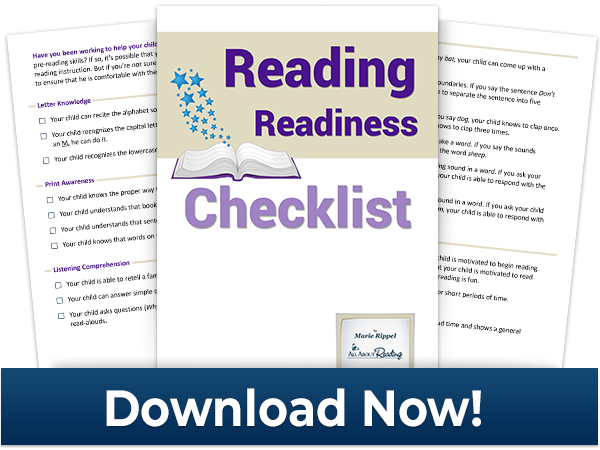
After completing this checklist, you’ll be able to identify the pre-reading skills that your child still needs to work on. The All About Reading Pre-reading program makes it easy to fill in the gaps and get your child ready to read. Is your child already ready to read? If so, All About Reading Level 1 is the perfect starting point!
One Final Note
I’m a strong believer in letting kids be kids and not pushing academics too early. But I also know from extensive experience that most kids don’t develop reading readiness skills on their own. The All About Reading Pre-reading program strikes a good balance. In about 15 minutes per day (depending on your child’s attention span and abilities), this easy-to-use curriculum helps children develop all five of the Big Five Skills. The program includes crafts, rhyming and word games, alphabet charts, and lots of playful activities. And if you’ve never met Ziggy, you’re in for a treat!
The majority of a young child’s day should be filled with play, real-life activities, and physical exploration. Add in just a touch of daily intentional instruction in these five reading readiness areas, and your child will have a huge advantage when it comes time to read.
Do you have questions about reading readiness? Post in the comments below or contact us!
Photo credit: Rachel Neumann


Comments
No comments yet. Our team reads and replies to every one.