


If your child has recently finished All About Reading, my first piece of advice to you is…celebrate! Have a piece of cake. Call Grandma and Grandpa. Take the rest of the day off and go to the park!
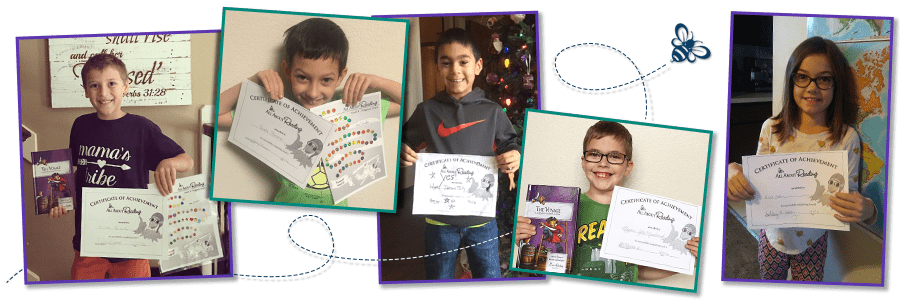
And of course, don’t forget to document this milestone and send us a photo! It makes my day when we hear from kids like Katie who complete our program! The accomplishment feels fantastic, doesn’t it?
Now your child has a rock-solid base upon which to grow in reading ability. First celebrate–then come back here for some ideas about what comes next.
Let’s take a quick look at the big picture, then we’ll dig into specifics.
The Two Major Stages of Reading
There are two major stages of reading: “Learn to Read” and “Read to Learn.”
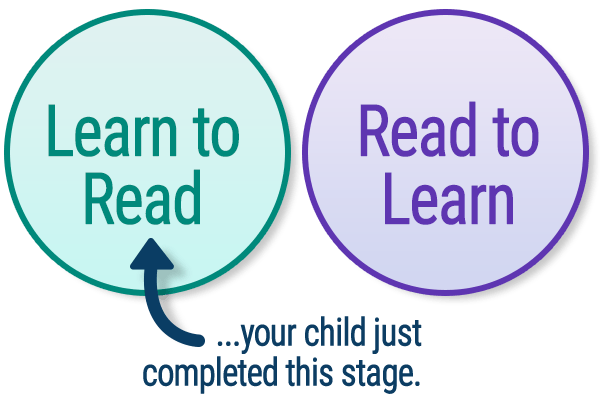
After your child has completed four levels of All About Reading, she’s officially done with the “Learn to Read” stage.
She now has the phonics and word attack skills necessary to sound out just about any familiar word. She can figure out words by dividing them into syllables, making analogies to other words, sounding out the word with the accent on different word parts, and recognizing suffixes and prefixes.
Now your child is ready for the next major reading stage: “Read to Learn.”
At this stage, reading is used to gain knowledge. Your child will grow in her ability to react to information and connect ideas. The possibilities for her to explore the world around her are limitless, and she can embark on this exploration through reference books, trade books, text books, magazines, and an endless array of literature. Ideally, this stage has no end; your child will “read to learn” for the rest of her school career—and beyond.
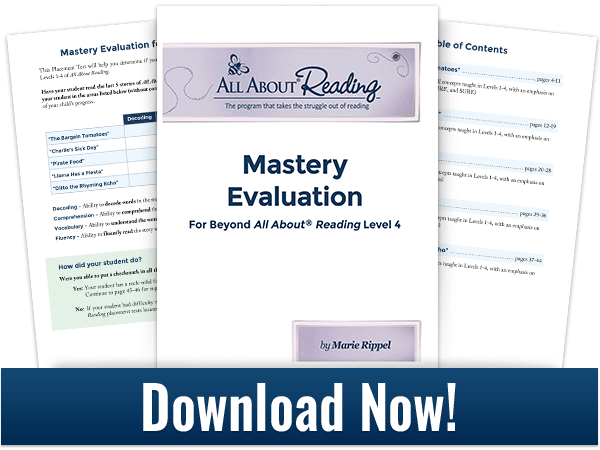
Download our Mastery Evaluation to be sure that your child has mastered the “learn to read” stage and is ready for the “read to learn” stage.
Recommendations for the “Read to Learn” Stage
The “Read to Learn” stage does not require formal instruction like the “Learn to Read” stage does. As your child moves away from learning to read, her knowledge and vocabulary should grow and her reading should become more automatic. But that doesn’t always happen entirely on its own. You will need to be proactive to ensure that your child continues to grow as a reader and as a learner.
Have your child read for 30 minutes every day.
Help your child choose reading material that is interesting to him, both fiction (such as great chapter books) and nonfiction (such as kid-friendly magazines). For more ideas, check out resources such as Honey for a Child’s Heart by Gladys Hunt and IEW Book Recommendations (from IEW’s free download page).
Work on building your child’s vocabulary.
For most kids, reading and being read to are the best ways to do this. But for some great practical tips, be sure to check out this comprehensive article about building your child’s vocabulary.
What About Literature?
A study of literature is an important component of the “Read to Learn” stage, but for many kids, studying literature can easily become a “drag.” Remember, your goal during the “Read to Learn” stage is to encourage reading and to help your child continue to develop fluency and confidence, so it’s important to let your child be drawn into the joy of reading.
How do you make a study of literature more interesting? Here are a few ideas.
- Engage in discussions about things in the book that interest your child.
- Have your child search for great descriptive writing that really pulls her into the story.
- Discuss a character that your child empathizes with. How does she feel about a choice the character makes? Would she make the same choice that the character makes?
- Is there a particularly interesting setting or theme in the story?
- Discuss a character in the story that your child would like to know in real life.
- Discuss how the story relates to an interesting period in history that you have studied with your child. How does understanding that history help you understand the story?
While encouraging your child to read independently is important, reading good literature aloud to your child is a great way to model your own thought processes. This will help your child learn to engage more effectively with what she’s reading, and will help her grow more confident in her own comprehension ability.
Whether your child reads alone or together with you, be sure that your discussions are light and natural. You’ll have a good feel for how well your child is understanding the reading as you talk with her about the book or story. Too much “analysis” can make a child dread reading, or worse, make her think she isn’t doing it “right.”
If you are looking for a more formal approach to teaching literature, here are a few literature guides our customers have found helpful.
- Lightning Literature (from Hewitt Homeschooling)
- Teaching the Classics (from Institute for Excellence in Writing)
- Essentials in Literature (from Essentials in Writing)
- Veritas Press Comprehension and Study Guides (recommended by Laura C.)
- Progeny Press Study Guides (recommended by Sarah M.)
- Moving Beyond the Page (recommended by Karen S.)
- Memoria Press Literature Guides (recommended by Erica F.)
Please Share Your Experience!
Has your child finished All About Reading Level 4? Share a photo on Facebook or Instagram, or email it to us at photos@allaboutlearningpress.com. We’d love to celebrate with you!
And if you have ideas for encouraging the “Read to Learn” stage, please share in the comments below.


Comments
No comments yet. Our team reads and replies to every one.