


Vocabulary plays an important part in learning to read. For example, when a beginning reader sees the word dog in a book, he begins to sound it out. When he realizes that he is very familiar with the word dog, he reads it with confidence.

But what if the child comes across the word yak in a story? If he has never heard of a yak, he may try to sound out the word, but may then begin to second guess himself. Is this a real word? Have I decoded it properly?
A similar thing can happen with older students, too. If a student comes across the word bovine but it’s not in his vocabulary, he may become frustrated.
A large vocabulary is critical for reading comprehension. This article will show you how to include vocabulary development in your child’s educational plans, as well as some pitfalls to avoid.
Four Types of Vocabulary
When we talk about vocabulary, we are actually talking about four related vocabularies. In order from largest to smallest they are:
- Listening vocabulary (words we can hear and understand)
- Reading vocabulary (words we can understand when we read)
- Speaking vocabulary (words we use when we talk)
- Writing vocabulary (words we use when we write)
For younger students who are still learning to read, speaking vocabulary is generally larger than their reading vocabulary. But for older readers who are past the “learning to read” stage and who have entered the “reading to learn” stage, this is the typical order.
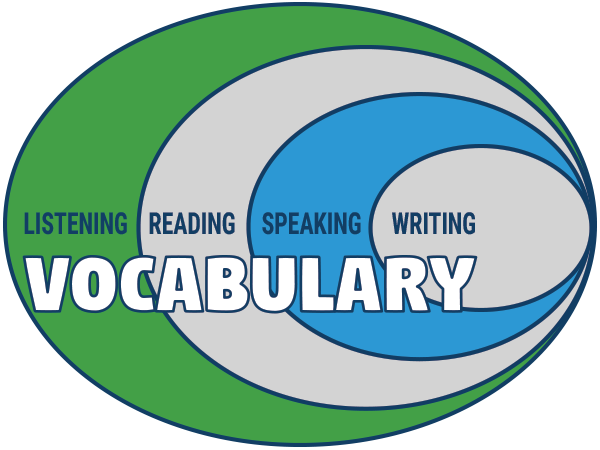
There is a high correlation between the four vocabularies. Growth in one area generally leads to growth in another. But is it possible for you to influence this growth? The simple answer is YES!
So let’s look at how to increase your child’s vocabulary.
Two Main Approaches to Vocabulary Development
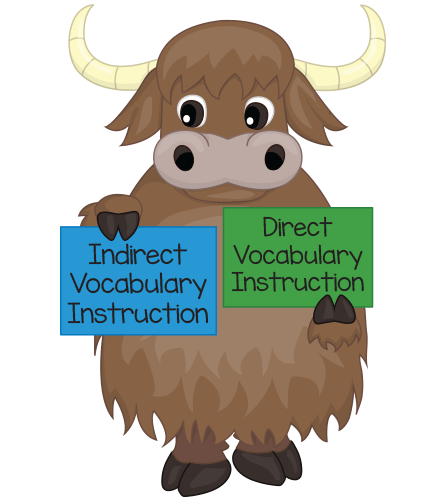
Most vocabulary is attained through indirect methods:
- Daily conversation
- Independent reading
- Read-alouds
- Oral discussions
- Movies
Direct vocabulary instruction includes things such as:
- Formal vocabulary curriculum
- Word analysis
- Teaching roots, suffixes, and prefixes
- Concept maps
Both indirect and direct methods of building vocabulary are important, but let’s look at what doesn’t work when trying to build your child’s vocabulary.
Five Common Mistakes in Teaching Vocabulary Words
Does this routine sound familiar?
It’s Monday–time to learn a new list of twenty vocabulary words. The children look up the words in the dictionary and copy the definitions. On Tuesday they will use the words in a sentence, and on Wednesday they will complete a fill-in-the-blank worksheet or even a fun vocabulary crossword puzzle. On Friday there will be a quiz on the twenty words. Then, whether they remember last week’s words or not, on Monday it will be time to start all over again.
Although many of us were taught vocabulary words this way, even the most compliant kids groaned inwardly at this demotivating routine.
Here’s the problem: the list-on-Monday, test-on-Friday approach to teaching vocabulary simply isn’t effective. It does, however, illustrate these common mistakes:
- Assigning too many new vocabulary words at one time.
- Teaching vocabulary words out of context.
- Expecting students to recall vocabulary words after a single exposure to the word.
- Making vocabulary development a boring topic that kids want to avoid.
And then there is a fifth common mistake:
- Skipping vocabulary development entirely.
And this is really where the rubber meets the road. Vocabulary that is developed naturally rather than taught using the more traditional method above is much more likely to stick with your child.
How Does All About Reading Build Vocabulary?
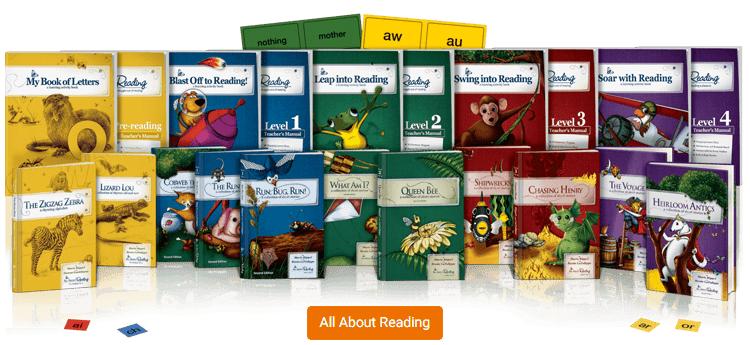
Each story lesson in the All About Reading program includes direct and indirect vocabulary lessons that offer a variety of ways for your child to learn new words. The sampling below shows the range of vocabulary-building activities that can be found in AAR lessons.
Vocabulary words are illustrated and then used in the next story.
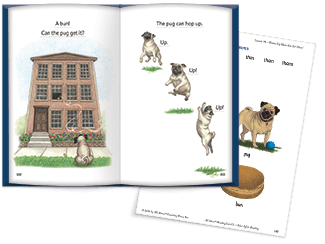
Though this is perhaps the simplest type of vocabulary lesson, it is effective because it allows children to form pictures of concrete nouns in their minds. In this AAR Level 1 example, students are introduced to the words pug and bun before encountering the words in the story “Get Them!”
Download the Warm-Up Sheet from Level 1
Download Level 1 Story: “Get Them!”
The names of countries and world regions are introduced.
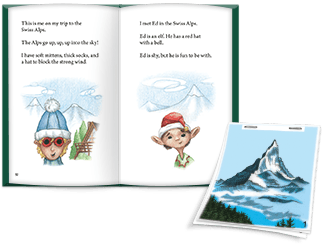
This AAR Level 2 lesson introduces children to the mountain region of the Swiss Alps with an easy-to-make minibook and an engaging story.
Download a minibook activity from Level 2
Download Level 2 Story: “An Elf in the Swiss Alps”
Idioms such as “hold your horses” are explained.
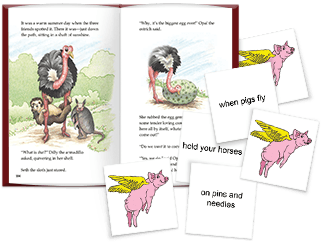
AAR Level 3 introduces twelve idioms in an activity called “When Pigs Fly.” Many of these idioms are encountered in “Chasing Henry” and subsequent stories.
Download an idiom activity from Level 3
Download Level 3 Story: “Chasing Henry”
Dialects used in other regions or by specific groups of people can present interesting challenges.
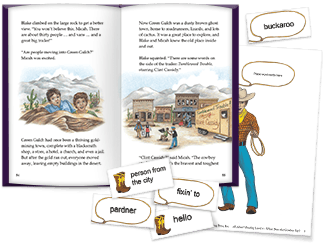
The AAR Level 4 activity “What Does the Cowboy Say?” introduces children to vocabulary and regional idioms such as reckon and fixin’ to, which in turn allows them to fully enjoy the story “Cowboy Star.”
Download a dialect activity from Level 4
Download Level 4 Story: “Cowboy Star”
Greek word parts provide clues to the meaning of many words.
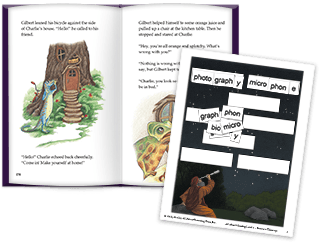
And finally, AAR Level 4 includes an activity called “Borrow a Telescope” that introduces children to eleven common Greek word parts and related vocabulary words. Some of these words are featured in “Charlie’s Sick Day” and subsequent short stories.
Download a word building activity from Level 4
Download Level 4 Story: “Charlie’s Sick Day”
Other vocabulary activities feature homophones, concept maps, morphemic strategies, and words that have origins in other languages such as French, Spanish, and Italian.
Research shows that children also learn a huge number of words from engaging in conversation with the adults around them. So as a parent, how can you leverage this knowledge for your child’s benefit?
The Conversational Method for Teaching Vocabulary
The conversational method is a powerful way to help build your child’s vocabulary. It is an indirect method that is so simple that you can start using it right after you read this article.
In a nutshell, the conversational method is simply talking with your child and expanding upon vocabulary words that your child has not yet learned.
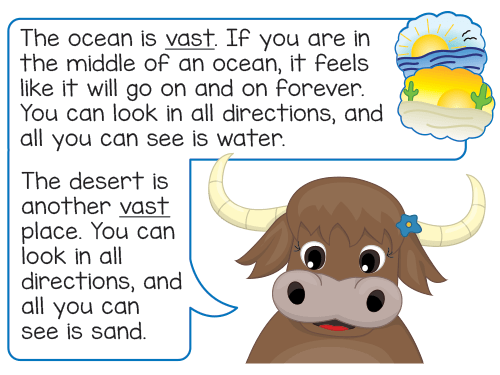
Step 1: When a new word comes up in conversation or in a book, provide a simple, age-appropriate definition for the new word.
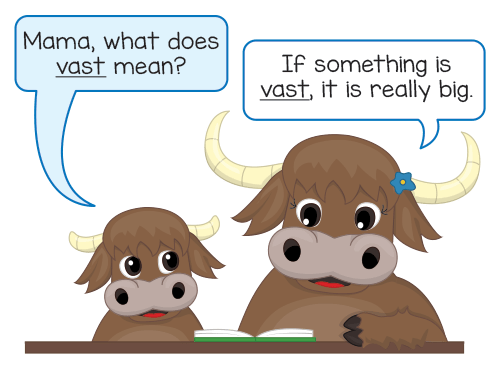
Step 2: Provide one or two examples that make sense to your child.
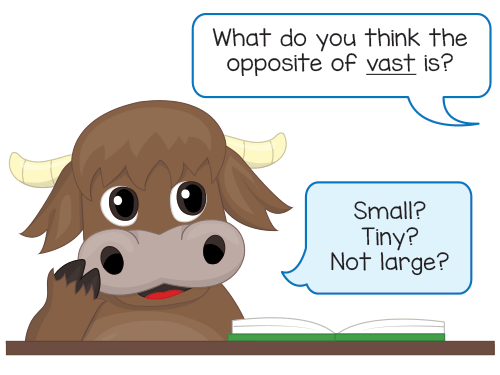
Step 3: Encourage your child to think of his own example, or of the opposite of the new word.
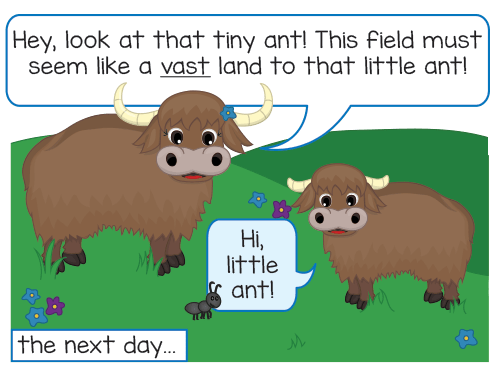
Step 4: Use the new word in conversation over the next few days.
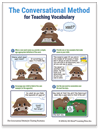
You can download this simple chart and hang it on your fridge to remind yourself of the four steps. Soon this method will become second nature to you, and your child’s vocabulary will grow by leaps and bounds.
Research Studies about Vocabulary Instruction
All About Reading is a research-based program, and I spend considerable time keeping up on the latest language arts-related studies. My job is to ensure that we’re doing everything we can to help children learn to read. There is a large body of research that backs up our claim that vocabulary growth is critical for reading, especially as students approach high school.
Click to read a sampling of research studies.
- The size of one’s vocabulary is strongly correlated to how well text is understood, even at the high school level.
Stanovich, K. & Cunningham, A. (1992). Studying the consequences of literacy within a literate society: The cognitive correlates of print exposures. Memory & Cognition, 20(1), 51-68; Beck & McKeown (2007). Increasing young low-income children’s oral vocabulary repertoires through rich and focused instruction. Elementary School Journal, 107(3), 251-271. - Growth in oral vocabulary development can predict reading comprehension.
Elleman, A., Lindo, E. Morphy, P. & Compton, D. (2009). The impact of vocabulary instruction on passage-level comprehension of school-age children: a meta-analysis. Journal of Educational Effectiveness, 2(1), 1-44. - Adults’ conversations with children facilitate vocabulary growth.
Mol, S. Bus, A., & deJong, M (2009). Interactive book reading in early education: a tool to stimulate print knowledge as well as oral language. Review of Educational Research, 79(2), 979-1007. Mol, S. & Neuman, S.B. (2012). Sharing information books with kindergarteners: the role of parents’ extratextual talk and socioeconomic status. Ann Arbor: University of Michigan. - Discussion about morphology (such as root words and affixes) improves vocabulary.
Bowers, P. N., Kirby, J.R., & Deacon, S. H. (2010). The effects of morphological instruction on literacy skills: a systematic review of the literature. Review of Educational Research, 80(2), 144-179.
The Bottom Line for Building Vocabulary
When it comes to building your child’s vocabulary, here’s what you need to keep in mind:
- Avoid the common mistakes in teaching vocabulary, as outlined in this article.
- Teach specific new vocabulary words using direct instruction.
- Discuss word parts so your child can learn word construction.
- Read lots of books aloud to your child and have informal conversations about new words that arise.
- And finally, have fun playing with words!
The All About Reading program walks you and your child through all the steps needed to help your child’s vocabulary grow. The program is multisensory, motivating, and complete, with everything you need to raise a strong reader. And if you need a helping hand, we’re here for you.
What’s your take on encouraging a larger vocabulary? Have anything else to share? Let me know in the comments below!


Comments
No comments yet. Our team reads and replies to every one.